Last updated: September 2026
If you are asking how many solar batteries you need for home backup, start with the loads you want to keep running rather than the size of your house. Battery capacity tells you how much energy is stored, while battery and inverter power determine what can run at the same time.
This guide gives you a simple way to estimate battery storage before you ask installers for quotes. It is a planning guide, not an electrical design. Final sizing should be checked against your actual circuits, equipment startup loads, solar production and local electrical requirements.
Quick answer: How many solar batteries does a home need?
For essential-load backup, one modern home battery in roughly the 10–15 kWh class can be enough for many households. Broader whole-home backup often needs more capacity, especially if you want to run air conditioning, electric cooking, water heating or pumps. Going fully off-grid is a different problem and can require substantially more storage because the system must survive nights and periods of weak solar production.
The better question is: how many usable kWh do I need, and how many kW must the system deliver?
The simple solar battery sizing formula
Start with the energy you expect to use while the grid is down:
Required backup energy (kWh) = average backup load (kW) × backup time (hours)
If your essential circuits average 0.6 kW and you want 12 hours of backup, the simple energy requirement is 7.2 kWh. Real systems also have reserve settings, conversion losses and changing loads, so do not size a purchased system from the theoretical number alone.
Solar battery count examples
| Backup goal | Example energy target | Typical planning approach |
|---|---|---|
| Fridge, router, lights, charging | Low daily energy use | Start by comparing one 10–15 kWh-class battery |
| Essentials plus more household circuits | Moderate | One larger battery may work; two can extend runtime |
| Whole-home use with HVAC | High | Often needs multiple batteries and careful power sizing |
| Off-grid autonomy | Very high | Size for worst-case solar conditions, not an average day |
These are planning categories, not guarantees. Two homes with the same floor area can have completely different electrical loads.
Step 1: Decide what must stay on
Make a short outage list. Refrigerator, freezer, internet, a few lights, phones and laptops are very different from central air conditioning, an electric oven, dryer, well pump and EV charger.
EnergySage’s 2026 sizing guidance makes the same core point: battery count depends on what you need to power, how long you need it, and the usable capacity of the batteries. It notes that current residential batteries commonly fall around the 10–13.5 kWh range.
Step 2: Separate kW from kWh
kWh is runtime. It tells you how much energy the battery stores.
kW is power. It tells you how much equipment the system can support at once.
You can have plenty of stored energy and still be unable to start a large motor if the inverter cannot provide the required power or surge. This is why battery sizing based only on your monthly electricity bill is incomplete.
Step 3: Estimate outage energy use
For each essential appliance, estimate average energy use during the outage period. Appliances such as refrigerators cycle on and off, so their rated running watts should not automatically be multiplied by 24 hours as if the compressor runs continuously.
Your smart meter, solar monitoring app or circuit monitor is much better than a generic internet estimate. If you do not have those, use appliance labels and manufacturer information as a starting point and leave a reasonable margin.
Step 4: Decide how long you want backup
A system designed for a four-hour outage is very different from one designed for two cloudy days. Solar can extend runtime by powering the home and recharging the battery during daylight, but production depends on weather, season, array size and system configuration.
Step 5: Convert storage into battery units
Once you have a usable-storage target, divide it by the usable capacity of the battery you are considering. For example, a 20 kWh target could be approached with two 10 kWh batteries or with a different combination of larger modules. Then check whether the combined system also supplies enough continuous and surge power.
One battery vs two batteries
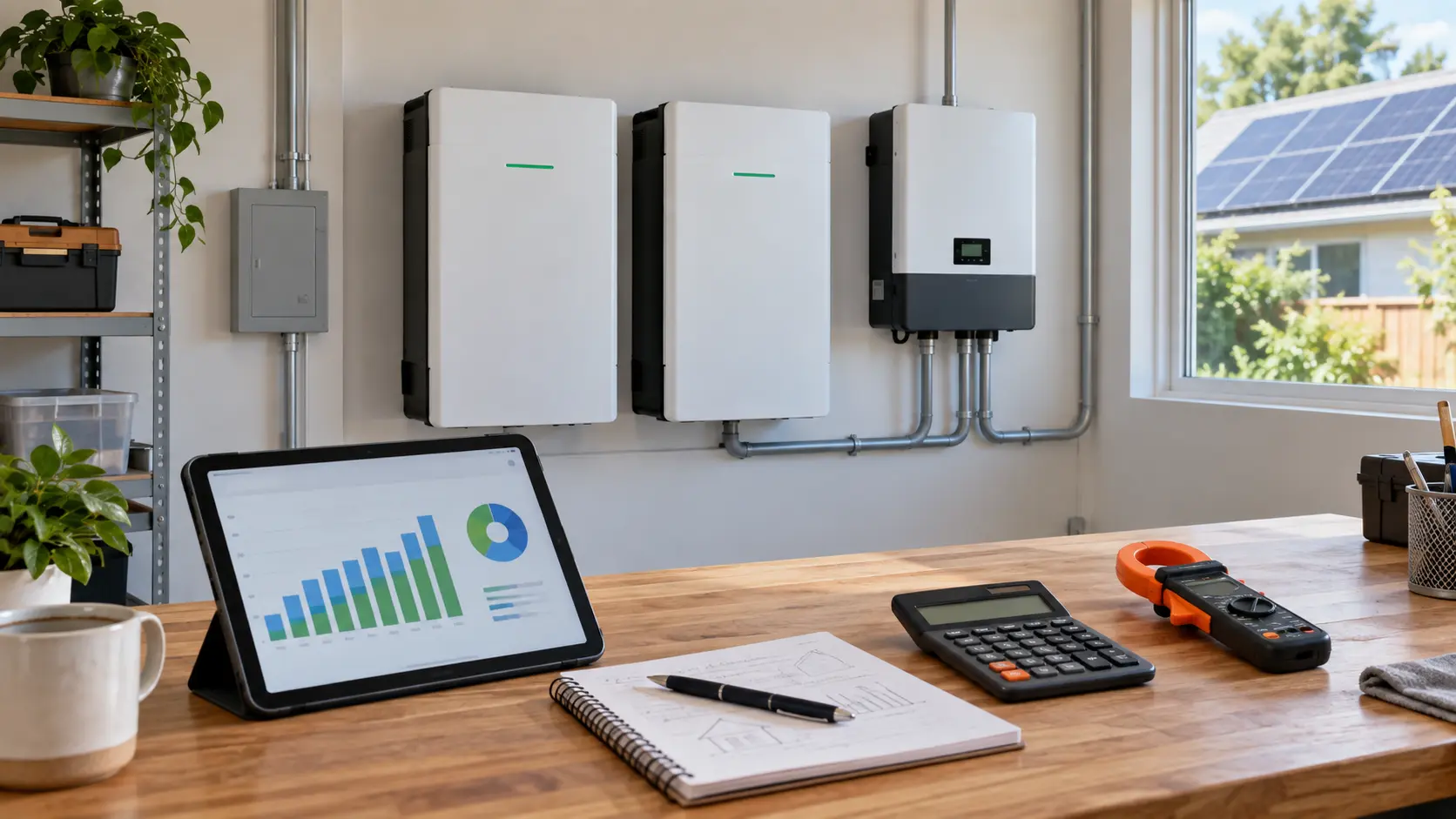
One battery can be the sensible choice when your goal is outage essentials and you are willing to manage large loads. A second battery becomes more useful when you need longer runtime, more evening solar self-consumption or additional system power.
Do not buy a second battery only because an installer calls it “whole-home backup.” Ask for a load calculation and an estimated outage runtime based on your home.
How solar changes the calculation
Without solar recharge, stored energy only goes down during an outage. With a correctly configured solar-plus-storage system, daytime solar can run loads and recharge the battery. That can turn a one-night battery into a much more resilient system when sunshine is available.
But do not assume the battery will fully recharge every day. A large battery paired with a small solar array can remain partly depleted after a cloudy day.
Common battery-sizing mistakes
- Sizing from house size: square footage does not tell you electrical demand.
- Ignoring startup loads: pumps and compressors can need much more power when starting.
- Using nameplate capacity instead of usable capacity: compare the energy actually available under the system’s operating rules.
- Assuming whole-home means unlimited: a system can be connected to the whole panel and still have power and runtime limits.
- Ignoring solar recharge: outage duration depends on both consumption and new energy coming in.
- Oversizing without a reason: extra batteries cost money and may spend most of their life unused.
Example: sizing an essentials backup
Suppose your essential loads average 500 W across the outage. For 12 hours:
0.5 kW × 12 hours = 6 kWh
A battery with 10 kWh of usable storage gives theoretical headroom above that energy target. But you still need to confirm inverter output, startup loads, reserve settings and whether the manufacturer quotes usable or nominal capacity.
Example: sizing for heavier household use
If your outage load averages 2 kW, the same 12-hour target becomes:
2 kW × 12 hours = 24 kWh
That immediately moves the design into a multi-battery range for many current residential products. Reducing HVAC or other high-energy loads during an outage can therefore save thousands compared with trying to reproduce normal grid-connected behavior.
Which battery size should you compare?
Our Best Solar Battery Backup System for Home guide compares current systems including Tesla Powerwall 3, FranklinWH aPower 2, Enphase IQ Battery 10C and modular alternatives. Tesla currently lists Powerwall 3 at 13.5 kWh, while Enphase lists the IQ Battery 10C at 10 kWh usable. The right number of units depends on the calculation above, not the brand name.
Frequently asked questions
Is one 10 kWh solar battery enough?
It can be enough for selected essential loads through a short or moderate outage. It is much less likely to provide unrestricted whole-home operation when large electric loads are included.
How many batteries do I need for 24 hours?
Calculate the kWh used by your chosen backup loads over 24 hours, then compare that requirement with usable battery capacity. A home using 8 kWh of outage energy needs a very different system from one using 30 kWh.
How many batteries do I need to run air conditioning?
There is no safe universal number. You need the air conditioner’s running power, startup requirement, expected runtime and the battery system’s continuous and surge output. Ask the installer to model the exact HVAC equipment.
Should I size batteries from my electricity bill?
Your bill is useful for understanding normal daily energy use, but it does not show which loads you will actually use during an outage or their simultaneous power demand. Combine bill data with an outage load list.
The bottom line
For most homeowners, the best way to answer “how many solar batteries do I need?” is to stop thinking in battery count first. Define your essential loads, calculate the kWh needed for the outage duration you care about, check simultaneous kW and startup loads, then translate that requirement into battery units.
One 10–15 kWh-class battery can be a sensible starting point for essential backup. Larger whole-home goals can quickly require two or more batteries. Get at least two installer designs and ask both installers to show their load and runtime assumptions before you buy.