Last updated: October 2026
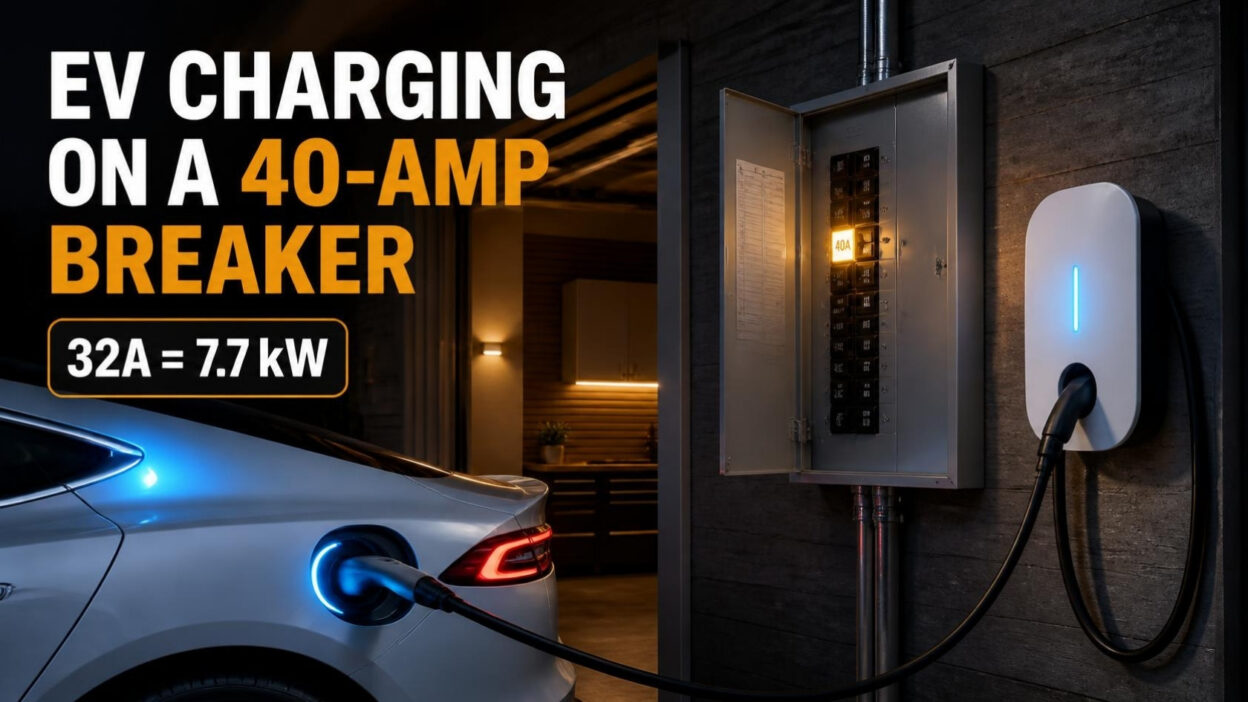
Yes, you can charge an EV on a 40-amp breaker. Because EV charging counts as a continuous load, a 40-amp circuit supports a charger set to 32 amps. At 240 volts that’s about 7.7 kW, which adds roughly 20–30 miles of range per hour, depending on the vehicle. For most drivers, that refills a full day’s driving overnight with time to spare.
Why a 40-amp breaker means 32-amp charging
In the US, EV charging is treated as a continuous load, one that can run for three hours or more. Continuous loads may draw only 80% of the breaker’s rating. Put the other way, the circuit has to be sized at 125% of the charger’s current.
- 40A breaker × 80% = 32A charging
- 50A breaker × 80% = 40A charging
- 60A breaker × 80% = 48A charging
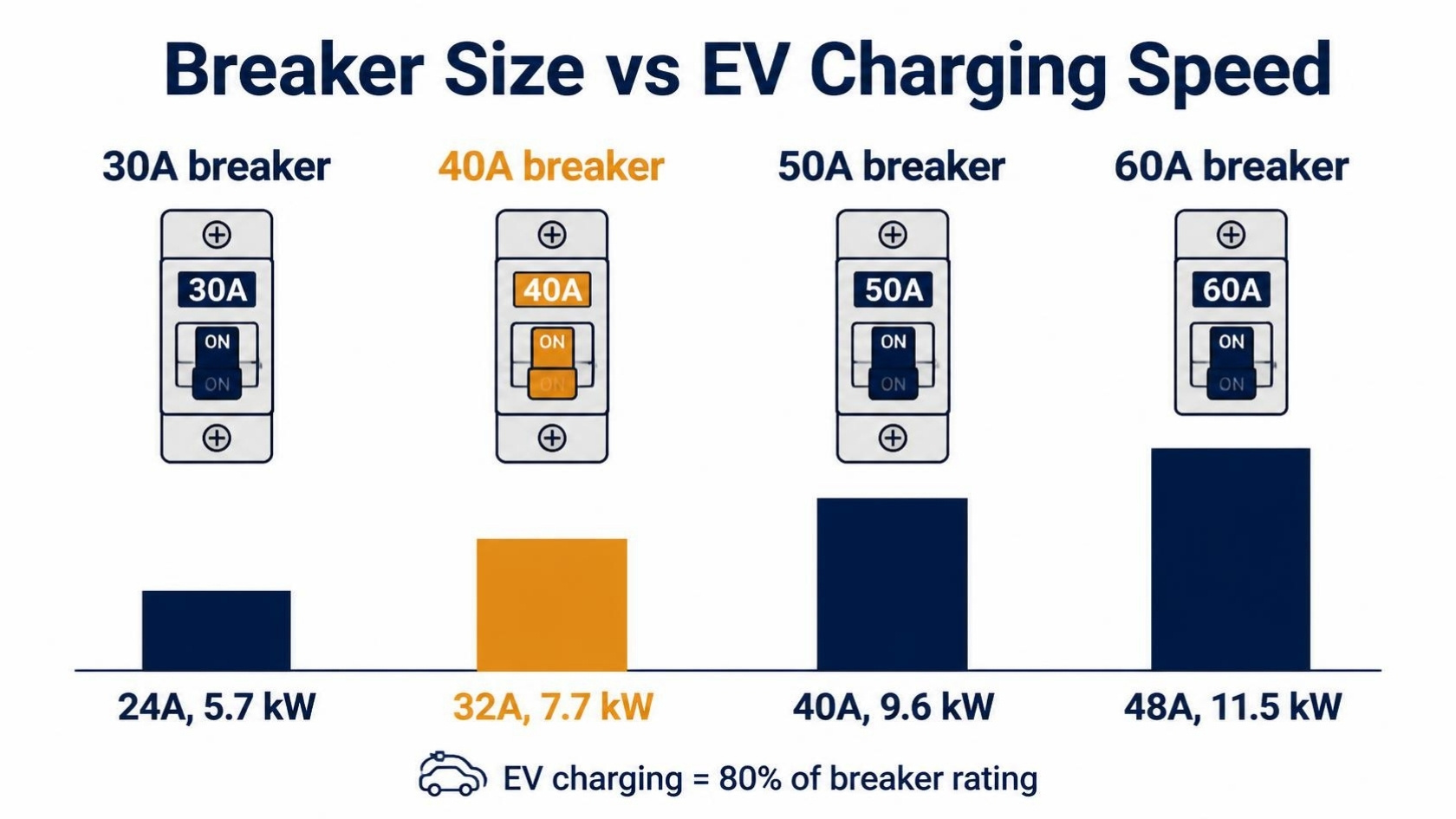
Power is volts × amps, so 240V × 32A = 7,680 watts, or about 7.7 kW. On 208V service, common in apartments and condos, the same 32A gives about 6.7 kW.
How fast is 32-amp charging?
Tesla publishes miles-of-range-per-hour figures for each breaker size. They give a useful real-world sense of the difference:
| Breaker | Charging current | Power at 240V | Model 3 / Model Y (miles per hour) | Model X (miles per hour) |
|---|---|---|---|---|
| 30A | 24A | 5.7 kW | 22 | 17 |
| 40A | 32A | 7.7 kW | 30 | 23 |
| 50A | 40A | 9.6 kW | 37 | 29 |
| 60A | 48A | 11.5 kW | 44 | 35 |
Source: Tesla Wall Connector support page. Less efficient vehicles such as trucks and large SUVs add fewer miles per hour at the same power.
Overnight, that adds up quickly
Over a 10-hour overnight window, 7.7 kW delivers up to about 77 kWh before charging losses. That’s more than most drivers use in several days. A driver covering 40 miles a day at about 3.5 miles per kWh needs roughly 11–12 kWh, or around 1.5 hours at 32A.
| Daily driving | Energy needed (approx.) | Time at 32A / 7.7 kW |
|---|---|---|
| 30 miles | 9 kWh | About 1 hr 10 min |
| 60 miles | 17 kWh | About 2 hr 15 min |
| 100 miles | 29 kWh | About 3 hr 45 min |
| Full charge, 75 kWh battery from 10% to 90% | 60 kWh | About 7 hr 50 min |
Estimates assume 3.5 miles per kWh and ideal charging. Real sessions take a little longer because of conversion losses, cold weather and tapering near the charge limit.
Your car may not go faster than 32 amps anyway
The vehicle’s onboard charger decides how much AC power it will accept. Tesla notes that the rear-wheel-drive Model 3 and Model Y, and the all-wheel-drive Model Y, top out at 32A (7.7 kW). For those cars, a 40A breaker delivers the full home charging speed, and a 50A or 60A circuit would add nothing.
Check your owner’s manual for “maximum AC charging rate.” Roughly:
- 7.2–7.7 kW = about 30–32A: a 40A circuit is all you need
- 9.6 kW = 40A: needs a 50A circuit for full speed
- 11.5 kW = 48A: needs a 60A circuit for full speed (see our 40-amp vs 48-amp comparison)
When a 40-amp circuit is the right choice
- Your panel is near capacity. A 40A circuit adds less load than a 50A or 60A one and may avoid a costly panel or service upgrade.
- Your EV maxes out at 32A. A bigger circuit gives no extra speed.
- The wire run is long. Smaller circuits can mean smaller, cheaper conductors, which adds up over long garage or outdoor runs.
- You charge overnight. If the car is parked 8+ hours, 7.7 kW covers almost any normal daily driving.
Upgrade to a 50A or 60A circuit when your car accepts more than 32A and you regularly need lots of range in a short window: long commutes, rideshare driving, two EVs sharing one charger, or a short off-peak electricity window.
Choosing a charger for a 40-amp circuit
You don’t need a special “32-amp charger.” Most quality Level 2 chargers let the installer set the maximum current to match the circuit. When buying, look for:
- Adjustable current that can be set to 32A, configured at installation (usually in an app or with an internal switch)
- A safety listing from a recognized lab (UL, ETL or CSA)
- The right connector, J1772 or NACS, for your car
- Hardwired or plug-in to suit your installation; see our plug-in vs hardwired guide
Chargers like the Tesla Wall Connector, Emporia, ChargePoint Home Flex and Grizzl-E Classic all offer adjustable current. Compare them in our best Level 2 home EV chargers guide.
A note on NEMA 14-50 outlets
A NEMA 14-50 receptacle is rated 50 amps and is normally installed on a 50A circuit. If an existing outlet is on a 40A breaker, any charger plugged into it must be set to 32A or lower. Whether that setup is acceptable depends on local code and the charger’s instructions, so have an electrician check it rather than guessing. Our NEMA 14-50 requirements guide covers receptacle quality and GFCI rules.
Safety checklist before you charge
- Never set the charger above 32A on a 40A breaker. Nuisance tripping is the best case; overheated wiring is the worst.
- Confirm the wire size and condition. An existing 40A circuit may have been installed for a different appliance. Your electrician should verify the conductors, terminations and breaker.
- Use a dedicated circuit that serves only the charger.
- Don’t use extension cords or adapters to reach a circuit that wasn’t meant for charging.
- Get permits where required. The US Department of Energy notes that many areas require permits and some require an approved site plan before installation.
Wondering what the electrical work costs? Our home EV charger installation cost guide breaks down labor, permits and panel upgrades.
Want to see what your charger really draws?
A circuit-level home energy monitor shows exactly how much power your EV charger uses, when it charges and what it costs, alongside the rest of the house. It’s also a helpful way to see how much spare capacity your panel has before upgrading.
Frequently asked questions
Can I put a 40-amp EV charger on a 40-amp breaker?
No. A charger drawing 40A continuously needs a 50A breaker. On a 40A breaker, the charger must be set to 32A or lower.
Is 32 amps enough for an EV?
For most drivers, yes. 32A adds roughly 20–30 miles of range per hour and can deliver around 75 kWh across a 10-hour night, more than a typical day’s driving uses.
How many kW is a 40-amp breaker for EV charging?
About 7.7 kW at 240V (32A × 240V). On 208V service it’s about 6.7 kW.
Can I use my dryer’s 30-amp circuit to charge an EV?
A 30A circuit supports 24A charging, about 5.7 kW. It can work with the right charger settings and receptacle, but sharing with a dryer requires a listed sharing device or a dedicated circuit. Ask an electrician.
Will a 40-amp circuit damage my EV battery?
No. The car controls how much current it accepts, and Level 2 charging at 32A is gentle on the battery.