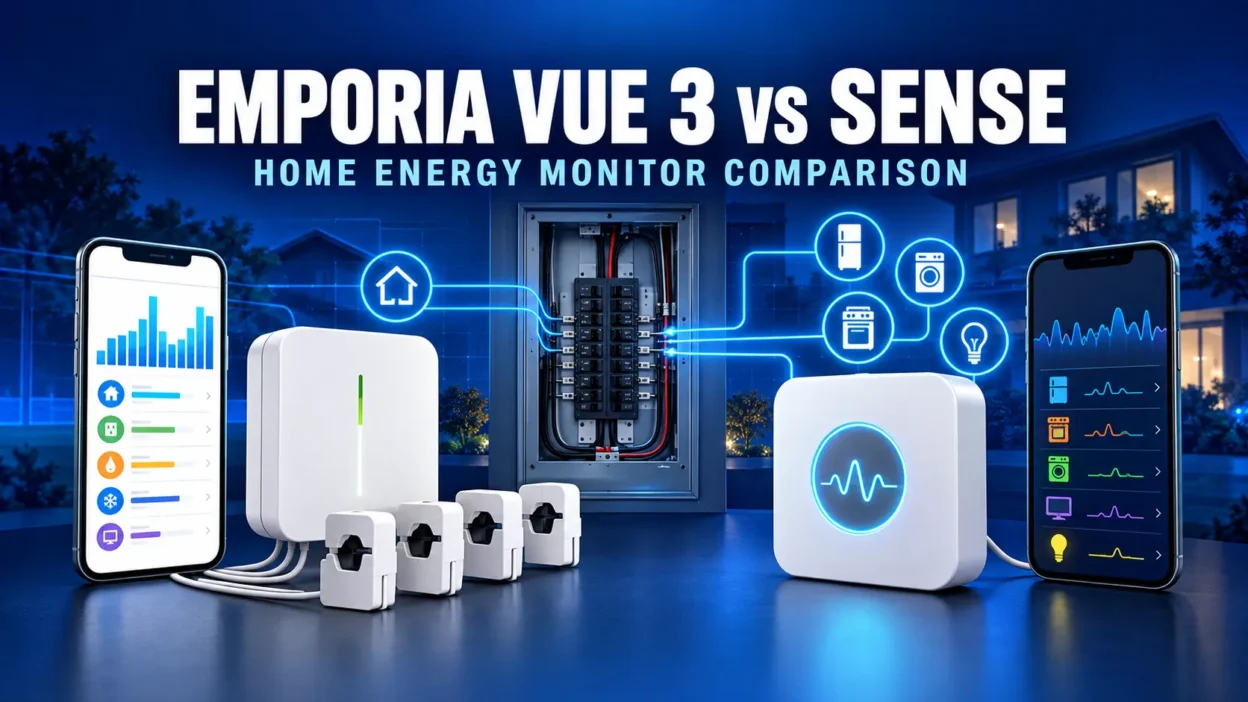
Emporia Vue 3 and Sense take very different approaches to home energy monitoring. Emporia measures the main supply and selected circuits with individual current sensors. Sense watches the home’s combined electrical signal and uses software to identify appliance patterns over time.
That difference matters more than headline specifications. Emporia is usually the better choice if you want dependable circuit-by-circuit data as soon as installation is complete. Sense is more appealing if you want automatic appliance detection and are comfortable waiting while its software learns your home.
Research note: This comparison is based on current manufacturer documentation and support information. We did not claim hands-on testing. Product availability, app features and utility integrations can change.
Quick verdict
Choose Emporia Vue 3 if you want to monitor specific circuits, compare large loads, track solar production or use measured energy data for battery sizing. Its readings are tied to physical sensors, so you know which circuit the data represents.
Choose Sense if you prefer a simpler dashboard that attempts to identify individual appliances automatically. It can be more engaging to use, but detection takes time and it may not find every appliance.
For most homeowners who want predictable measurements rather than software estimates, Emporia Vue 3 is our practical recommendation. Sense remains an interesting option for users who value automated device discovery and live whole-home insights.
Emporia Vue 3 vs Sense at a glance
| Feature | Emporia Vue 3 | Sense Home Energy Monitor |
|---|---|---|
| Primary method | Main and branch-circuit current sensors | Whole-home waveform analysis and software detection |
| What you see first | Whole-home use and monitored circuits | Whole-home use; detected devices appear gradually |
| Device identification | By the circuit labels you assign | Automatic detection based on electrical signatures |
| Typical learning period | No learning period for circuit data | Days to weeks; usefulness improves over roughly 30–90 days |
| Branch monitoring | Up to 16 branch sensors per Vue | No individual branch sensors in the standard setup |
| Solar monitoring | Yes, on the inverter’s AC output | Supported with compatible hardware configuration |
| Subscription | No required subscription for core monitoring | No subscription for the supported consumer service |
| Regional support | Compatible with many common residential electrical systems | Official consumer hardware support is limited to the US and Canada |
| Best for | Reliable circuit-level measurement | Automatic appliance discovery |
How Emporia Vue 3 works
The Vue 3 installs inside or near the electrical panel. Two main current transformers normally measure the home’s incoming service, while smaller sensors can monitor up to 16 selected branch circuits. The monitor sends readings over 2.4 GHz Wi-Fi to the Emporia app.
This approach is direct. If a sensor is clipped around the refrigerator circuit, the app reports the total consumption of that circuit. There is no waiting period for an algorithm to recognize the load.
However, a circuit is not always the same as one appliance. A kitchen circuit may serve several outlets, and multiple lights may share one breaker. Clear circuit labels and sensible sensor placement are essential if you want useful results.
Emporia says the Vue samples electrical activity frequently and provides real-time, historical and alert data through its app. You can read more in Emporia’s official explanation of how the Vue works.
How Sense works
Sense uses sensors on the home’s main electrical feeds, but its central idea is different. Instead of assigning one sensor to each selected circuit, it studies the combined electrical waveform and looks for recognizable signatures when devices switch on, run and turn off.
You receive whole-home real-time information soon after setup. Named devices appear gradually as the system gathers enough examples. Sense says useful device detection commonly develops over the first 30 to 90 days, although results vary between homes.
This can feel almost magical when it works: the app may show a refrigerator, garage-door opener or other repeating load without a separate sensor on that circuit. The tradeoff is uncertainty. Some devices may never be identified, similar devices can be grouped together, and variable-speed equipment is often harder to separate.
Sense explains its detection approach on its official product page and describes the early learning period in its support documentation.
Circuit monitoring or appliance detection: which is better?
Emporia is better for questions with a known circuit
Emporia works well when you want answers such as:
- How much power does the electric water heater circuit use?
- What is the daily energy use of the home office?
- How much solar power reaches the AC panel?
- What is the combined demand of the circuits planned for backup?
Because the data comes from a selected circuit sensor, it is easier to connect the number to a practical decision. This is especially valuable when you are trying to measure appliance energy use before buying a backup battery.
Sense is better for discovery
Sense is designed for people who do not want to map many branch circuits manually. Its automatic detection can reveal recurring loads and show when a recognized appliance operates.
The limitation is that the list of detected devices is not guaranteed to become a complete inventory. If a critical appliance is never separated from the home’s combined signal, you may still need a plug-in energy meter or smart plug to measure it accurately.
Installation and electrical-panel compatibility
Both products involve work inside an electrical panel. That enclosure can contain energized conductors even when the main breaker is switched off. Use a licensed electrician unless you are legally permitted, trained and equipped to perform this work.
The Vue 3 requires its main sensors, any selected branch sensors, a power connection and enough physical space for the monitor and wiring. Emporia documents compatibility with many single-phase, split-phase and three-phase 120/240-volt systems, but unusual panels and tightly packed enclosures need extra checking. Review the current Vue compatibility guidance before buying.
Sense also uses sensors on the main service conductors and requires power plus an internet connection. Homes with solar, generators, multiple panels or 400-amp service may require a different sensor arrangement or additional hardware.
Before ordering either monitor, photograph the panel label, note the service type and count the circuits you actually need to track. If the panel is full or the service conductors are difficult to access, ask an electrician to confirm fit first.
Solar monitoring
Emporia can monitor solar production when a compatible current sensor is placed around the inverter’s AC output. Its current transformers are not designed for the solar array’s DC conductors. The app can then compare household consumption, grid flow and generation when the sensors are configured correctly.
This makes the Vue a natural companion to our guide on sizing solar batteries for a home. Measured daytime consumption and solar export are more useful than relying only on a monthly electricity bill.
Sense supports solar monitoring with a compatible hardware configuration and flex sensors. If Sense is provided through a participating utility’s smart meter rather than a separately installed monitor, available solar features may differ. Verify the exact version before purchase or enrollment.
For technical placement details, see Emporia’s official solar-monitoring instructions.
Apps, alerts and historical data
Both platforms offer real-time and historical views, but the organization reflects their measurement methods.
Emporia emphasizes total usage and named circuits. You can compare time periods, create usage notifications and inspect a particular circuit when its consumption changes. The experience is analytical and works best when the circuit labels are accurate.
Sense emphasizes the live home “bubble” view, detected devices and activity patterns. It is designed to make energy use easy to explore, especially when the software has successfully identified several important loads.
Neither system should be treated as a utility-grade billing meter. Use the readings for trends, load planning and identifying unusual consumption. Your electricity provider’s meter remains the billing reference.
Cloud dependence, privacy and long-term support
Both products rely heavily on cloud services for their consumer apps and analysis. That enables remote access and software improvements, but it also means the experience depends on the manufacturer continuing to operate the platform.
Sense’s position deserves special attention in 2026. The company says it is shifting its focus toward energy intelligence built into utility smart meters. Existing consumer hardware monitors remain supported, but prospective buyers should confirm current hardware availability, regional service and the features offered by their utility.
Sense also states that its consumer hardware is officially available for the United States and Canada. Installing it elsewhere can affect support and warranty coverage. Emporia supports a wider range of common residential electrical arrangements, though buyers should still check local voltage, panel layout and electrical rules.
Review each company’s privacy policy before connecting a monitor. Detailed energy patterns can reveal when major appliances operate and when household activity changes.
Which monitor gives more accurate information?
“Accuracy” depends on what you are trying to measure.
Emporia gives more dependable attribution to a monitored circuit. If the sensor is installed and configured correctly, the reading belongs to that conductor. It may still represent several devices sharing the circuit.
Sense gives more convenient attribution to a detected appliance, but that label is produced by pattern recognition. Detection confidence and coverage vary. The system can provide an excellent whole-home view while still missing individual devices.
If you need a measurement for battery capacity, generator planning or a large electrical upgrade, verify important loads with a dedicated circuit sensor, plug-in meter or manufacturer specification. Our home energy monitor buying guide explains the other monitoring options.
Which one should you buy?
Buy Emporia Vue 3 if:
- You want data for specific breakers immediately.
- You need to compare large loads or prepare a backup-power plan.
- You want to monitor solar production at the inverter’s AC output.
- You prefer physical measurement over automatic device guesses.
- You may need more than one monitor for multiple panels or many circuits.
Buy Sense if:
- You want automatic appliance discovery.
- You enjoy a visual, activity-focused app.
- You are willing to let the system learn for several weeks.
- You accept that some appliances may remain unidentified.
- You are in the US or Canada and have confirmed current availability or utility support.
Consider a smart plug instead if:
You only need to measure one plug-in appliance. A compatible energy-monitoring smart plug or plug-in meter is cheaper, easier to install and often more precise for that single load. Neither Emporia nor Sense can directly separate every appliance in every home.
Frequently asked questions
Does Emporia Vue 3 identify individual appliances?
Not automatically in the same way as Sense. It reports the total use of each monitored circuit. If one appliance has a dedicated circuit, the circuit reading closely represents that appliance. Shared circuits combine multiple loads.
How long does Sense take to detect appliances?
Whole-home data appears quickly, but named devices can take days or weeks. Sense advises that the system generally becomes more useful during the first 30 to 90 days. It may not identify every appliance.
Do Emporia or Sense require a monthly subscription?
Current consumer information indicates that neither requires a monthly subscription for its core monitoring service. Always check the terms offered with the exact hardware or utility program before buying.
Can either monitor help size a home battery?
Yes, but Emporia’s circuit-level data is usually easier to use for a defined essential-load panel. Measure both daily energy in kilowatt-hours and peak demand in watts. Our portable power-station sizing guide explains how those two numbers affect backup selection.
Can I install a home energy monitor myself?
Installation rules vary, but working inside a service panel can be fatal. Manufacturer instructions are not a substitute for electrical training. A licensed electrician is the safest choice and may be required by local regulations.
Final recommendation
Emporia Vue 3 is the stronger choice for most readers who want actionable measurements. It starts producing circuit-level data without a learning period and fits naturally into solar, battery and high-load planning.
Sense offers a more automated experience. Its appliance detection can reveal useful patterns with little manual labeling, but buyers must accept incomplete detection and confirm the product’s current hardware or utility availability.
If your goal is to reduce an electricity bill or plan backup power, begin with the question you need answered. Choose Emporia for known circuits, Sense for discovery, and a plug-in meter for one specific appliance.