A NEMA 14-50 outlet can be a convenient way to charge an electric vehicle at home, but the receptacle is only one part of a safe installation. The circuit, breaker, conductors, connections, charger settings, location and local electrical rules all need to work together.
This guide explains the main NEMA 14-50 outlet requirements for EV charging, including why a 50-amp outlet normally supplies no more than 40 amps to an EV charger. It is intended to help homeowners plan a professional installation—not to replace an electrician or local inspection.
Safety note: EV charging is a continuous high-power load. Do not open an electrical panel, alter wiring or install a 240-volt receptacle unless you are qualified and legally permitted to do so. A licensed electrician should evaluate the panel, circuit and installation location.
Quick answer: What does a NEMA 14-50 EV charging setup require?
A typical home EV charging installation using a NEMA 14-50 receptacle needs:
- A dedicated 240-volt branch circuit
- A breaker and conductors sized for the circuit and installation conditions
- A properly grounded NEMA 14-50 receptacle and enclosure
- GFCI protection when required by the locally adopted electrical code
- An EV charger that is listed for plug-in use and configured within the circuit limit
- Permits and inspection where required
- Correct mounting, terminal torque and weather protection
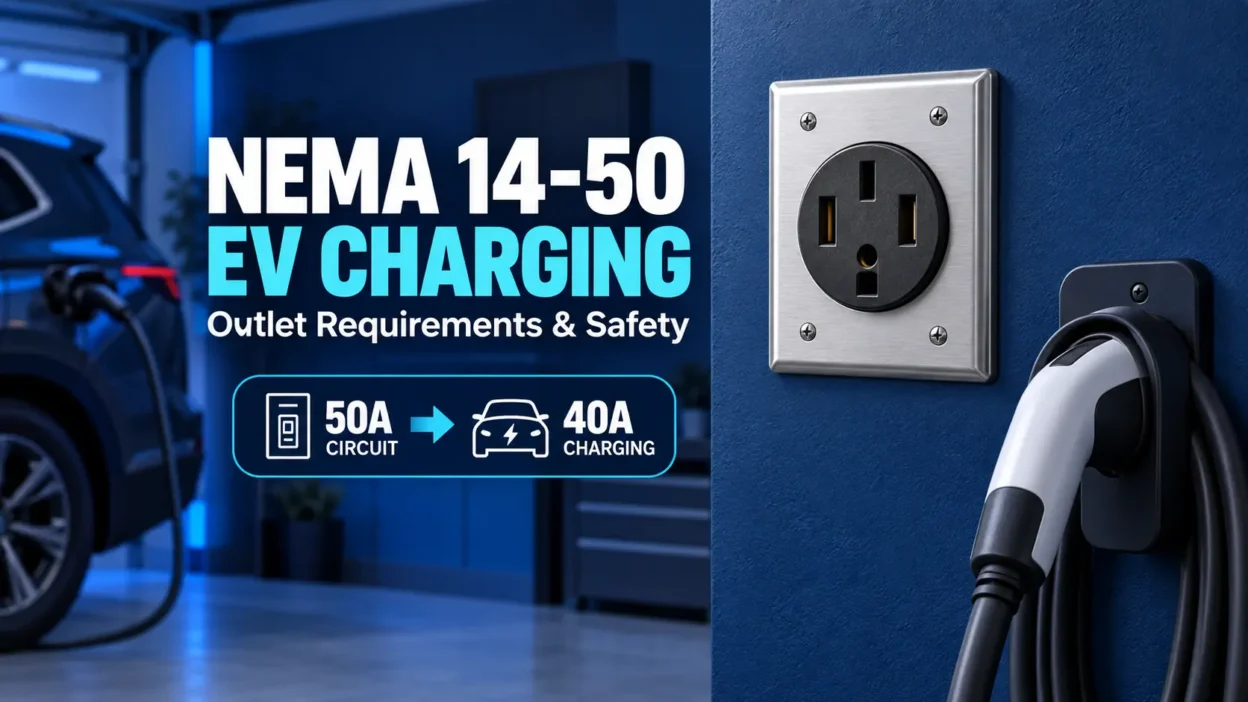
On a 50-amp circuit, a plug-in charger is generally limited to 40 amps of continuous output. Some portable charging cords draw only 32 amps even when connected to a NEMA 14-50 outlet.
| Item | Typical planning point |
|---|---|
| Outlet configuration | NEMA 14-50, four-prong, 125/250-volt, 50-amp configuration |
| Circuit use | Dedicated to the EV charging equipment |
| Maximum continuous charging on a 50A circuit | Usually 40A |
| Faster 48A charging | Normally hardwired on a properly designed 60A circuit |
| Installation | Licensed electrician and local permit/inspection as required |
What is a NEMA 14-50 outlet?
A NEMA 14-50 is a four-prong receptacle with two hot conductors, a neutral and an equipment grounding connection. It is commonly associated with ranges, recreational vehicles and some plug-in Level 2 EV chargers.
The familiar shape does not make every 14-50 installation equally suitable for vehicle charging. An EV can draw substantial current for several hours, often every day. That sustained duty places more stress on the receptacle and its connections than many occasional household loads.
The charger must also be designed for a NEMA 14-50 connection. Do not convert a hardwired charger into a plug-in unit or use an unapproved adapter simply because the plug fits.
Why a 50-amp outlet normally means 40-amp charging
EV charging is treated as a continuous load. A common electrical planning rule limits a continuous load to 80% of the branch-circuit rating. Applied to a 50-amp circuit:
50 amps × 0.80 = 40 amps
That is why a plug-in Level 2 charger connected to a correctly installed 50-amp circuit usually has a maximum setting of 40 amps. A 40-amp charger can deliver roughly 9.6 kW at 240 volts, although real charging power varies with voltage, the vehicle and operating conditions.
If you are deciding between outputs, see our detailed comparison of a 40-amp vs 48-amp EV charger. A charger delivering 48 amps normally needs to be hardwired to a properly sized 60-amp circuit rather than plugged into a 14-50 receptacle.
NEMA 14-50 outlet requirements checklist
1. A dedicated circuit
The EV charger should have its own branch circuit. Sharing a circuit with a range, dryer or another large appliance can overload the circuit or create an installation that does not comply with the charger instructions and local rules.
A device that automatically manages two loads may be an option in some homes, but it must be specifically listed and installed for that purpose. An ordinary splitter or multi-outlet adapter is not a substitute.
2. Correct breaker and conductor sizing
The breaker, conductor material, conductor size, insulation rating, terminals, conduit or cable method, ambient temperature and length of the run all affect the design. This is why one wire size should not be presented as universally correct for every 14-50 installation.
An electrician should also confirm that the service and panel have enough available capacity. If capacity is limited, load management may be more economical than a full electrical-service upgrade. Our home EV charger installation cost guide explains how panel condition, cable distance and permits affect the project price.
3. Proper grounding and neutral connections
A NEMA 14-50 receptacle has separate neutral and equipment-grounding connections. The circuit must be wired exactly as required by the receptacle, charger instructions and locally adopted code. Never use the ground as a neutral, remove a grounding pin or install an adapter that defeats grounding protection.
4. GFCI protection when required
Many current electrical codes require GFCI protection for receptacles in garages, outdoors and other specified locations. Local requirements depend on the code edition and amendments adopted by the authority having jurisdiction.
Some plug-in EV chargers also contain internal ground-fault protection. In certain installations, the interaction between the charger and a GFCI breaker can cause nuisance tripping. That does not justify bypassing required protection. The electrician should follow both the charger manufacturer’s instructions and the local inspector’s requirements.
5. A receptacle suitable for sustained EV charging
The receptacle and enclosure should be listed, correctly rated and installed according to the manufacturer’s instructions. All terminations must be prepared and tightened to the specified torque. Loose connections create resistance and heat—two major concerns during long charging sessions.
Price alone is not a reliable quality test. Ask the electrician to choose a receptacle appropriate for frequent, continuous high-current use and to follow the exact terminal and mounting instructions.
6. Safe mounting and cord position
The outlet should be firmly mounted where the charger cord can reach the vehicle without being stretched, pinched or creating a trip hazard. The plug should insert fully, and the charger body should be supported as directed rather than hanging from the receptacle.
A plug-in charger is not always intended to be connected and disconnected every day. Repeated cycling can wear the receptacle contacts. If the unit will remain at home, it is usually better to leave it connected as permitted by its instructions and use a suitable cable holder.
7. Weather protection for outdoor locations
An outdoor installation needs equipment and an enclosure approved for the location, including suitable protection while the plug is connected. Rain, condensation, snow, sunlight and physical damage all need consideration.
Do not assume that placing an indoor receptacle under a small roof makes it suitable for outdoor service. Ask the electrician to verify the enclosure rating and local requirements.
8. Permit and inspection where required
Many jurisdictions require an electrical permit and inspection for a new EV-charging circuit. Requirements vary, but the permit process helps confirm conductor sizing, grounding, protection, equipment listing and panel capacity.
Technical Safety BC, for example, states that most EV charger installations require a permit and recommends using a licensed electrical contractor. Check the rules for your own city, state, province or utility territory before work begins.
Can you reuse an existing dryer or range outlet?
Sometimes an existing outlet can be evaluated for EV charging, but it should not be assumed safe based on appearance. An electrician should verify:
- The exact receptacle type and circuit rating
- Whether the circuit is dedicated
- Conductor condition and grounding
- Breaker compatibility and required GFCI protection
- Signs of heat, wear, looseness or damaged contacts
- Whether the receptacle and circuit are suitable for sustained charging
- Available panel and service capacity
Older dryer outlets may be three-prong configurations without the separate connections expected by modern equipment. Do not use improvised adapters to make an incompatible outlet accept an EV charger.
NEMA 14-50 outlet vs hardwired EV charger
A plug-in installation makes the charger easier to remove or replace. It can also allow a compatible portable charging cord to be taken on a trip. However, the added plug-and-receptacle connection introduces another point that must remain tight and cool.
A hardwired installation removes that connection, is commonly preferred for outdoor locations, and can support higher outputs such as 48 amps when the charger and circuit are designed for it. It may also avoid some receptacle-specific requirements, though all applicable circuit and GFCI rules still need to be followed.
For a full decision guide, read plug-in vs hardwired EV chargers.
32-amp and 40-amp chargers on a NEMA 14-50 outlet
The outlet rating does not determine the charger’s actual output. A 32-amp portable connector can use a compatible 14-50 adapter yet remain limited to 32 amps. A listed plug-in wall charger may support up to 40 amps when installed on the appropriate 50-amp circuit.
ChargePoint, for example, lists a plug-in Home Flex configuration for a 240-volt outlet with compatible 40-amp or 50-amp circuit ratings. Always use the manufacturer’s setup table for the exact model rather than assuming its current from the plug shape.
If you are still comparing equipment, our best Level 2 EV chargers for home guide explains output, cable, connector and installation differences. We also have a focused EVIQO Level 2 EV charger guide.
Warning signs after installation
Stop charging and arrange an inspection if you notice:
- A plug or receptacle that becomes unusually hot
- A burning or hot-plastic smell
- Discoloration, melting or scorch marks
- A loose-fitting plug or crackling sound
- Repeated breaker or GFCI trips
- Intermittent charging or charger fault messages
Do not continue using the outlet while trying to “see if it happens again.” Heat damage can worsen quickly under a sustained load.
Questions to ask your electrician
- Does my service and panel have capacity for this charging load?
- Is a 50-amp dedicated circuit appropriate for this charger?
- What current setting will the charger use?
- Does the local code require a GFCI breaker here?
- Is the receptacle appropriate for sustained EV charging?
- Does the location require a weather-resistant enclosure?
- Are a permit and inspection required?
- Would hardwiring or load management be safer or more economical?
- What signs of overheating should I check after installation?
Frequently asked questions
Can I charge an EV at 48 amps from a NEMA 14-50 outlet?
No. A 14-50 circuit rated at 50 amps generally supports no more than 40 amps of continuous EV charging. A 48-amp charger normally requires a hardwired installation on a properly designed 60-amp circuit.
Does every NEMA 14-50 EV outlet need a GFCI breaker?
It depends on the locally adopted code, installation location and authority having jurisdiction. Many modern codes require GFCI protection for garage and outdoor receptacles. Your electrician and inspector should determine the requirement for your property.
Can I use an extension cord with a NEMA 14-50 EV charger?
Do not use an ordinary extension cord. Extra connections can add resistance, heat and weather exposure. Use only equipment and accessories expressly listed and approved by the charger manufacturer for that application.
Is a NEMA 14-50 outlet faster than a hardwired charger?
Not inherently. Charging speed depends on the circuit, charger and vehicle. A 14-50 setup normally tops out at 40 amps, while a compatible hardwired charger can be installed for 48 amps or more where the electrical system allows.
How often should the outlet be inspected?
Look for looseness, discoloration, damage and unusual heat during normal use. The appropriate professional inspection interval depends on equipment, usage and local guidance. Any warning sign warrants immediate evaluation.
Bottom line
A NEMA 14-50 outlet can provide practical Level 2 home charging, but it must be treated as a complete electrical system rather than a simple appliance outlet. A dedicated circuit, correct protection, professional installation and a charger limited to the circuit’s safe continuous current are essential.
For most 14-50 installations, plan around a maximum of 40 amps and compare that option with hardwiring before work begins. Start with our broader Home EV Charging guides if you want to explore the complete article cluster.