Quick answer: To measure appliance energy use before buying a home backup battery, record both the appliance’s running power in watts and its energy consumption in kilowatt-hours over a realistic period. A plug-in electricity meter or energy-monitoring smart plug is usually the simplest option for refrigerators, televisions, routers and other plug-in appliances. For hardwired equipment, use a professionally installed whole-home or circuit-level energy monitor.
Choosing a backup battery from the wattage printed on an appliance label can lead to the wrong result. The label may show a maximum rating, while the appliance may cycle on and off throughout the day. A refrigerator is a good example: it may draw a noticeable amount of power while its compressor is running but use far less energy than that wattage multiplied by 24 hours.
This guide explains how to measure real consumption, turn the results into a battery-capacity estimate and avoid the common mistake of confusing power with energy.
Why measure appliances before sizing a backup battery?
A battery must satisfy two different requirements:
- Power: The inverter must supply enough watts to operate the appliances at the same time.
- Energy: The battery must store enough watt-hours or kilowatt-hours to keep those appliances running for the required duration.
A system can have enough stored energy but still shut down if a motor, pump or compressor produces a startup surge above the inverter’s limit. The reverse can also happen: an inverter may comfortably start an appliance, but the battery may not have enough usable energy to operate it overnight.
If you are still comparing system sizes, our home solar battery sizing guide explains how daily energy use translates into the number of batteries required.
Watts, watt-hours and kilowatt-hours
These three units answer different questions:
| Measurement | What it tells you | Why it matters |
|---|---|---|
| Watts (W) | Power being used at a particular moment | Helps determine the inverter’s continuous-output requirement |
| Watt-hours (Wh) | Energy used over time | Useful for comparing appliance use with portable power-station capacity |
| Kilowatt-hours (kWh) | 1,000 watt-hours | Commonly used for home batteries and electricity bills |
The basic calculation is:
Energy in watt-hours = watts × hours of operation
To convert watt-hours to kilowatt-hours, divide by 1,000. The U.S. Department of Energy defines one kilowatt-hour as the energy used by one kilowatt operating for one hour. Source: U.S. Department of Energy.
For example, a 100-watt device running continuously for five hours would use:
100 W × 5 hours = 500 Wh, or 0.5 kWh
Real appliances are not always that simple. Refrigerators, freezers, pumps and air conditioners cycle, so measuring them over time is more reliable than assuming continuous operation.
Four ways to measure appliance energy use
1. Use a plug-in electricity meter
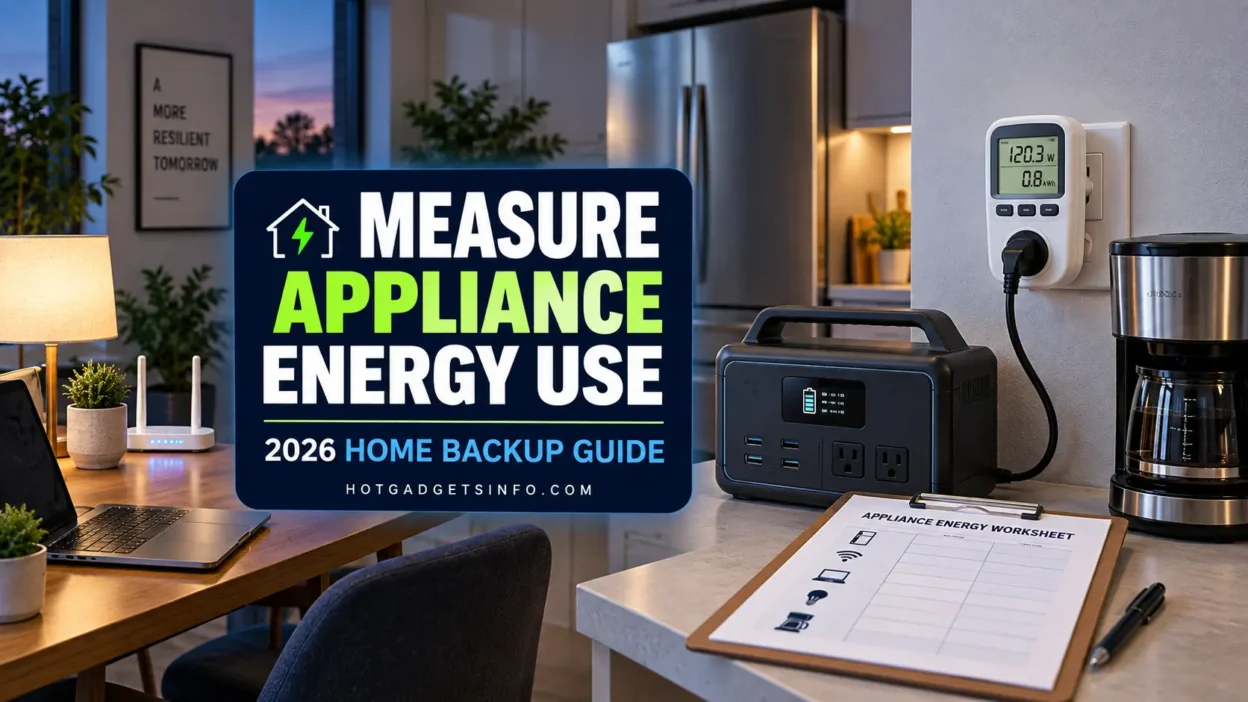
A plug-in electricity meter sits between the wall outlet and the appliance. It can display live watts and accumulate energy use in kWh. This is a practical method for:
- Refrigerators and freezers
- Wi-Fi routers and networking equipment
- Televisions and entertainment systems
- Desktop computers and monitors
- Fans, lamps and small kitchen appliances
Products such as the Kill A Watt are designed to measure household-appliance consumption and record total kWh. P3 International’s product information also notes that its meter retains measurements through power interruptions.
For appliances that cycle, leave the meter connected for at least 24 hours. A longer test—such as three to seven days—can provide a better average when usage changes from day to day.
2. Use a smart plug with energy monitoring
An energy-monitoring smart plug performs a similar job but records data in an app. Depending on the model, it may show live power, daily energy, historical charts and estimated cost.
This approach is useful when you want to observe consumption for several days without repeatedly checking a physical display. It can also reveal standby usage from devices that appear to be turned off.
Check the smart plug’s maximum current and power rating before connecting an appliance. Do not use a light-duty plug with a heater, air conditioner or another load that exceeds its rating.
3. Use a whole-home or circuit-level energy monitor
A whole-home monitor uses current-transformer sensors in the electrical panel to track overall use or individual circuits. Systems such as the Emporia Vue can monitor branch circuits and help identify which equipment is driving consumption. Emporia also documents support for measuring solar production, grid import and net metering when the sensors are positioned correctly. Source: Emporia solar-monitoring guidance.
This method is more appropriate for:
- Hardwired air conditioners
- Water heaters
- Well pumps
- Electric ovens
- Dedicated refrigerator or freezer circuits
- Homes where several essential circuits must be measured together
Safety note: Electrical panels contain dangerous voltages. Emporia’s current installation instructions recommend installation by a skilled person such as a licensed electrician or another qualified professional. Do not open or work inside a live electrical panel simply to collect measurements.
4. Calculate from a label or specification sheet
If measurement is not possible, use the appliance label, manual or manufacturer specification. This is the least precise method because the listed wattage may represent a maximum input rather than normal consumption.
For appliances with an annual energy label, divide the stated annual kWh by 365 to estimate average daily use:
Daily kWh = annual kWh ÷ 365
For example, an appliance rated at 365 kWh per year averages approximately 1 kWh per day. Actual use can still vary with temperature, settings, age, maintenance and household habits.
How long should you measure each appliance?
| Appliance type | Suggested measurement period | Reason |
|---|---|---|
| Router, modem or lamp | Several hours | Power draw is usually steady |
| Television or computer | One or more normal sessions | Consumption changes with brightness and workload |
| Refrigerator or freezer | At least 24 hours; preferably several days | The compressor cycles and usage changes with room temperature and door openings |
| Washing machine or dishwasher | One to three complete cycles | Heating, pumping and motor loads vary during a cycle |
| Air conditioner | Several representative days | Runtime changes considerably with weather and thermostat settings |
Measure under conditions that resemble an outage. If the goal is refrigerator backup, do not base the calculation on a day when the appliance was empty and the door remained closed unusually long.
Step-by-step battery sizing from measured data
Step 1: List only the essential loads
Start with the appliances that genuinely need backup. A typical essentials list might include a refrigerator, router, several LED lights, phone charging and a laptop. Adding electric cooking, water heating or central air conditioning changes the required system dramatically.
Step 2: Record the highest running watts
Use the meter’s live-power reading while each appliance operates normally. Add the appliances that may run at the same time. This gives an initial continuous-output target for the inverter.
Step 3: Record energy use in Wh or kWh
Use the accumulated energy reading, not just the live wattage. If a refrigerator uses 1.2 kWh during a 24-hour test, use 1.2 kWh as the starting daily figure rather than multiplying its compressor wattage by 24.
Step 4: Multiply by the required backup time
If your measured essential loads use 2.4 kWh per day and you want two days without charging:
2.4 kWh × 2 days = 4.8 kWh
Step 5: Account for conversion losses and reserve
Not every unit of stored battery energy reaches the appliance. The inverter, battery-management system, cabling and standby operation all consume energy. Avoid planning to use 100% of the advertised capacity.
A simple planning method is:
Required nominal capacity = measured load ÷ expected usable-system fraction
If the two-day requirement is 4.8 kWh and you use an illustrative 85% usable-system fraction:
4.8 ÷ 0.85 = 5.65 kWh
This does not mean every system has exactly 15% loss. Use the manufacturer’s usable-capacity and efficiency information when available.
Step 6: Check startup surge separately
Motors and compressors may briefly require more power when starting. A plug-in meter may not capture a very short peak accurately. Check the appliance documentation and compare the result with the battery inverter’s surge rating.
Our guide to refrigerator backup during a power outage explains why startup power and daily energy must both be considered.
Worked example: refrigerator, router, lights and laptop
Suppose your measurements produce the following results:
| Essential load | Measured daily energy |
|---|---|
| Refrigerator | 1.2 kWh |
| Router and modem | 0.3 kWh |
| LED lighting | 0.25 kWh |
| Laptop and phone charging | 0.35 kWh |
| Total | 2.1 kWh per day |
For one day of backup, the measured energy requirement is 2.1 kWh. Using the same illustrative 85% usable-system fraction:
2.1 ÷ 0.85 = 2.47 kWh
You would therefore compare systems with more than 2.47 kWh of nominal capacity, then verify continuous output, surge capability, outlet type and expansion options. Solar recharging may extend runtime, but it should not be treated as guaranteed during poor weather.
If you are considering a portable unit rather than an installed battery, see what size portable power station you need.
Common measurement mistakes
- Using label watts as daily energy: Watts and watt-hours are not interchangeable.
- Testing a cycling appliance for only a few minutes: Short readings can miss normal on-and-off behavior.
- Ignoring standby loads: Inverters, networking equipment and electronics may consume energy continuously.
- Adding every appliance in the house: Backup sizing should begin with essential loads unless the goal is whole-home operation.
- Ignoring simultaneous loads: Total inverter power depends on what can operate at the same time.
- Assuming solar production is constant: Weather, season, shading and panel orientation affect charging.
- Working inside an electrical panel without qualifications: Use a licensed electrician for panel-mounted monitoring equipment.
Home Backup Battery Sizing Calculator
Enter the appliances you want to run during an outage. The calculator estimates your daily energy requirement, battery capacity and inverter size.
| Appliance | Running watts | Startup watts | Hours/day | Qty | Remove |
|---|---|---|---|---|---|
Planning estimate: Actual consumption varies by appliance, duty cycle, temperature and battery condition. Verify motor startup requirements and manufacturer specifications before purchasing equipment.
A simple appliance-measurement worksheet
Create a table with these columns:
| Appliance | Running watts | Startup watts | Measured kWh | Measurement period | Required during outage? |
|---|---|---|---|---|---|
| Refrigerator | Record from meter | Check meter/manual | Record total | 24–72 hours | Yes/No |
| Router | Record from meter | Usually minimal | Record total | 24 hours | Yes/No |
| Lighting | Add selected lamps | Usually minimal | Estimate or measure | Normal evening | Yes/No |
Keep the measurement period beside each result. A reading of 0.6 kWh means very little unless you know whether it represents six hours, one day or one week.
Frequently asked questions
Can I size a battery from my electricity bill?
Your bill is useful for understanding whole-home consumption, but it does not identify which appliances must remain powered during an outage. Measure essential loads separately for a more realistic backup estimate.
Is appliance label wattage accurate enough?
It can provide a conservative starting point for some steady loads, but it is less reliable for appliances that cycle or change operating modes. Measured kWh over time is usually more useful for battery capacity.
Can a smart plug measure a refrigerator?
Yes, if the plug is rated for the refrigerator’s voltage, current and startup demand. Avoid undersized or poorly certified smart plugs. Do not use adapters that defeat grounding or electrical protection.
Do I need a whole-home energy monitor?
Not necessarily. A plug-in meter is sufficient for many essential appliances. A whole-home monitor becomes useful when you need circuit-level data, want to measure hardwired loads or plan a broader home-energy system.
Should I measure watts or kWh?
Measure both. Watts help determine whether the inverter can operate the appliances. kWh determines how long the stored energy may last.
The bottom line
Measure first and size the battery second. Record real kWh over a representative period, identify which loads can run simultaneously, check startup surge and leave room for system losses and reserve capacity.
This approach produces a more defensible estimate than relying on appliance labels or generic online wattage tables. Once you know your essential-load total, compare it with our guides to home solar battery systems, what a 10 kWh battery can run and the best portable power stations for home backup.