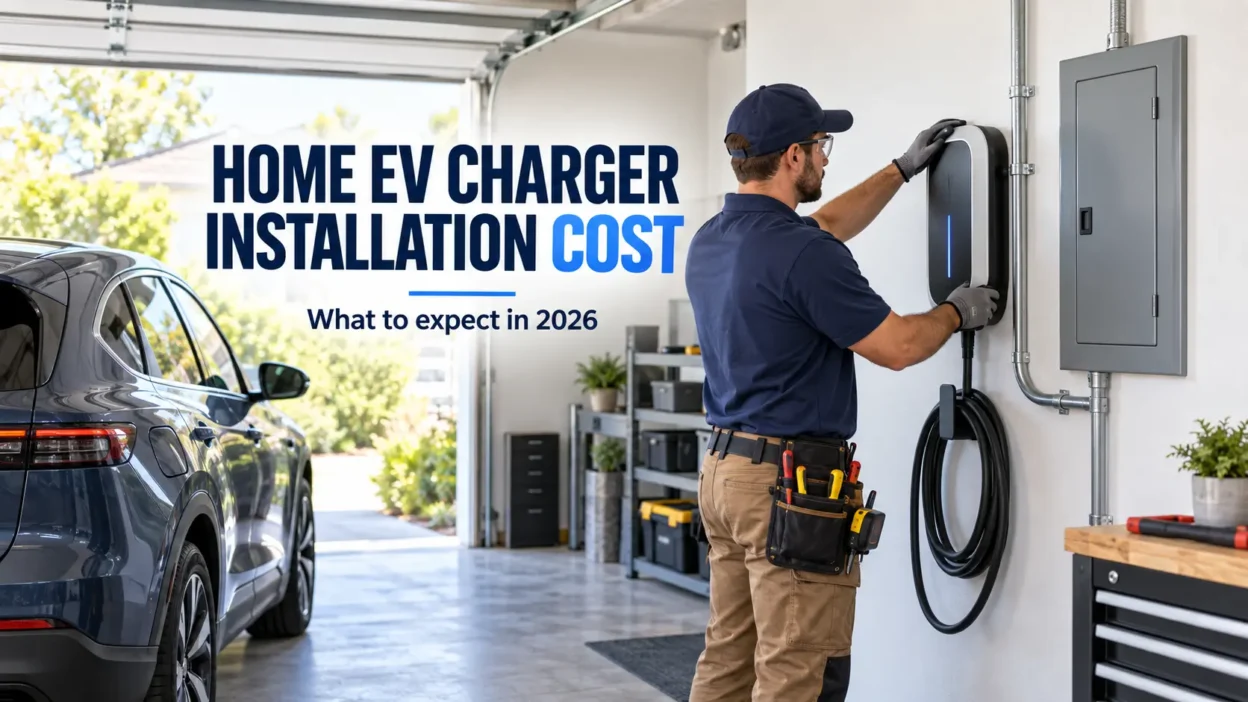
Installing a Level 2 EV charger at home can cost less than the charger itself—or several times more. The difference usually comes down to the distance from the electrical panel, available service capacity, amperage, permits and whether the job needs new equipment.
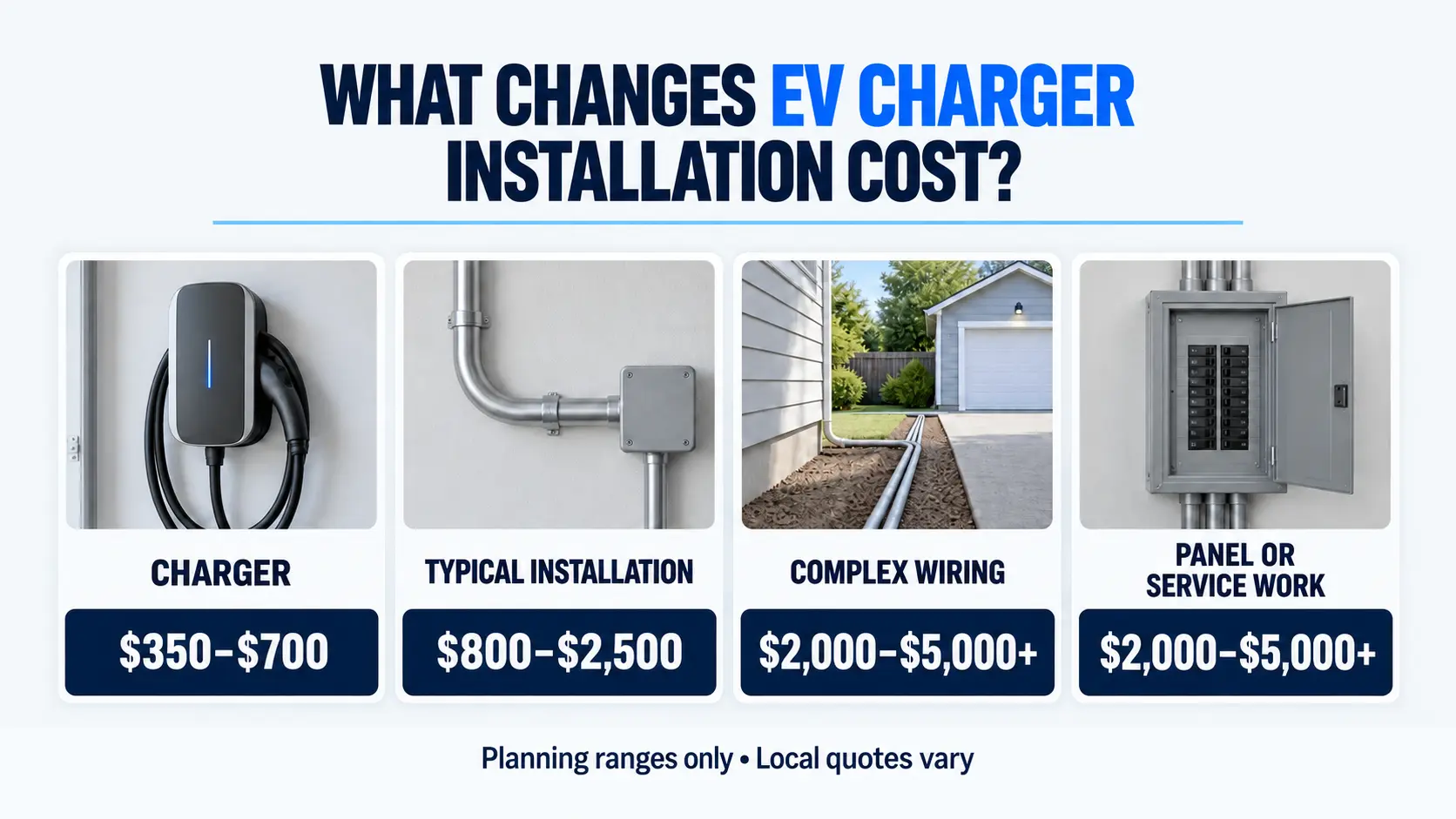
For a straightforward installation in the United States, a practical planning range is often $800 to $2,500 for the electrical work, before buying the charger. Simple jobs may cost less. Long wiring runs, difficult access, load-management hardware or a panel upgrade can push the total into the several-thousand-dollar range.
This guide breaks down home EV charger installation cost so you can understand a quote, identify the expensive parts and choose the right setup without paying for capacity you cannot use.
Home EV Charger Installation Cost at a Glance
| Project type | Typical planning range | What it usually involves |
|---|---|---|
| Very simple installation | $500–$1,000 labor and materials | Panel nearby, open breaker spaces and a short accessible cable route |
| Typical professional installation | $800–$2,500 labor and materials | New dedicated 240 V circuit, moderate cable run, mounting and testing |
| Complex installation | $2,000–$5,000+ | Long run, finished walls, trenching, detached garage or load management |
| Installation with major service work | $3,000–$8,000+ | Panel replacement, service upgrade or substantial site work |
These ranges exclude unusual structural repairs and vary widely by location. The safest way to budget is to request itemized quotes after an electrician has seen the panel and proposed charger location.
What Is Included in an EV Charger Installation?
A proper Level 2 installation normally includes more than mounting a box on the wall. Depending on the project, the electrician may provide:
- A load calculation or service-capacity assessment
- A dedicated two-pole circuit breaker
- Correctly sized conductors and conduit or cable
- A receptacle for a plug-in charger or direct hardwired connection
- Grounding and required protective equipment
- Wall mounting and cable routing
- Permit and inspection coordination
- Charger commissioning, current setting and functional testing
- Labels and basic documentation
Ask whether the quoted price includes the permit, inspection, drywall repair, trenching and charger setup. A low initial number can become less attractive if those items are later added separately.
EV Charger Hardware Cost
Many mainstream Level 2 home chargers fall around $350 to $700, although basic units can cost less and premium or bidirectional equipment can cost far more. Hardware price depends on output, connector, cable length, weather rating, safety certification, app features and warranty.
Higher amperage does not automatically make a charger the better value. First confirm the maximum AC rate your vehicle accepts and the circuit your home can support. Our 40-amp vs 48-amp EV charger comparison explains when the faster configuration is useful.
If you are still choosing equipment, see our researched guide to the best Level 2 EV chargers for home.
The Seven Biggest Installation Cost Factors
1. Distance from the electrical panel
Every additional foot can increase conductor, conduit and labor cost. A charger mounted beside a garage panel is usually far cheaper than one located across a finished house or in a detached garage.
Ask the electrician to compare two practical mounting positions. Moving the charger a few feet may shorten the cable route considerably while still allowing the charging cable to reach the vehicle safely.
2. Available panel and service capacity
An empty breaker position does not prove that the home can support another large continuous load. The electrician needs to consider the service rating and existing loads such as air conditioning, electric heat, a range, water heater, dryer and pool equipment.
If capacity is limited, possible solutions include:
- Configuring the charger for a lower current
- Using approved load-management equipment
- Installing a subpanel where appropriate
- Replacing or upgrading the main electrical panel
- Upgrading the utility service in more demanding cases
Load management may be less expensive than a full service upgrade, but equipment compatibility and local approval must be confirmed.
3. Charger amperage
A 32-amp, 40-amp and 48-amp charger do not use identical circuit requirements. In common U.S. residential installations, 40-amp charging is associated with a 50-amp circuit, while 48-amp charging normally uses a 60-amp circuit and a hardwired connection.
Higher current can require larger conductors and may expose capacity limits in the existing panel. If your vehicle cannot accept the higher rate, that additional cost provides no immediate charging benefit.
4. Plug-in versus hardwired installation
A plug-in unit may appear cheaper because it can be removed easily, but the installed cost includes a suitable receptacle, enclosure and any locally required protection. A quality receptacle intended for repeated high-load use is not the same as choosing the cheapest available outlet.
Hardwiring avoids the plug-and-receptacle connection and is normally required for 48-amp output. Costs depend on the charger and site rather than connection type alone. Read our plug-in vs hardwired EV charger guide before deciding.
5. Permit and inspection fees
Permit requirements and fees vary by jurisdiction. Some municipalities offer a straightforward residential EV-charger permit, while others require drawings, load calculations or additional review.
Do not skip a required permit to save money. Permitting and inspection help confirm that the circuit was installed according to applicable rules, and the paperwork may matter for insurance, warranty questions and a future home sale.
6. Cable routing and surface repairs
Finished walls, concrete, attic access, crawlspaces, fire-rated assemblies and exterior trenching can add labor. Ask who is responsible for patching drywall, repainting or repairing landscaping after the electrical work.
A surface-mounted conduit route in a garage may be less visually discreet but considerably cheaper and easier to inspect than opening multiple finished walls.
7. Location and local labor rates
Electrical labor and permit costs vary significantly by city and region. The same equipment and cable distance can produce different quotes depending on local wages, demand, travel time and inspection procedures.
How Much Does a Panel Upgrade Add?
A panel or service upgrade is often the single largest cost. As a broad planning range, panel-related work can add approximately $2,000 to $5,000 or more. Complex service changes, meter relocation, utility work or repairs required by the local authority can push the price higher.
Do not assume an upgrade is automatically necessary. Ask whether a lower charger setting or approved energy-management solution can meet your driving needs safely. A 32-amp charger supplies about 7.7 kW at 240 volts, which is enough for many overnight charging routines.
Example EV Charger Installation Budgets
Example 1: Panel beside the parking space
| Charger | $500 |
|---|---|
| Electrical installation | $700 |
| Permit | $100 |
| Estimated total | $1,300 |
This represents a simple project with a short cable route and sufficient existing capacity.
Example 2: Moderate cable run through a finished garage
| Charger | $550 |
|---|---|
| Electrical installation | $1,600 |
| Permit and inspection | $150 |
| Minor wall repair | $250 |
| Estimated total | $2,550 |
Example 3: Long run with load management
| Charger | $600 |
|---|---|
| Long circuit installation | $2,400 |
| Load-management equipment and setup | $1,000 |
| Permit and inspection | $200 |
| Estimated total | $4,200 |
These examples are illustrations, not quotes. Their purpose is to show why two homeowners buying the same charger can face very different totals.
Does the 2026 Federal Tax Credit Still Apply?
As of September 2026, homeowners should not assume a new installation qualifies for the federal Alternative Fuel Vehicle Refueling Property Credit. Current federal guidance says eligible property had to be placed in service before July 1, 2026.
If your qualifying installation was completed by June 30, 2026, keep invoices and consult current IRS instructions or a tax professional. Eligibility previously depended on requirements including the installation location.
For new projects, check:
- State incentive programs
- Local utility rebates
- Time-of-use electricity plans
- Automaker charger or installation offers
- Municipal electrification programs
Offers change frequently. Confirm availability and approval requirements before buying equipment or beginning work.
How to Get an Accurate EV Charger Installation Quote
Give each electrician the same information so the quotes are comparable:
- Your vehicle model and maximum AC charging rate
- The charger model and proposed amperage
- Photos of the main panel, labels and intended mounting area
- The approximate route between the panel and charger
- Whether the garage is attached or detached
- Any planned second EV, solar system, battery or major electric appliance
Request an itemized quote showing:
- Breaker and circuit rating
- Wiring method and approximate distance
- Plug-in or hardwired connection
- Permit and inspection responsibility
- Load-management or panel work
- Drywall, trenching and surface-repair exclusions
- Labor and workmanship warranty
Choose a licensed electrician familiar with EV charging equipment. The lowest quote is not automatically the best if it omits permitting, specifies an unsuitable receptacle or does not include the necessary load assessment.
How to Reduce Installation Cost Safely
- Install near the panel: A shorter route usually reduces material and labor.
- Match output to real needs: Do not pay for 48 amps if the vehicle or charging schedule does not benefit.
- Ask about adjustable chargers: A compatible unit can be commissioned at a lower current when capacity is limited.
- Compare load management with an upgrade: Request both options where permitted.
- Check rebates before purchase: Some programs require approved equipment or pre-authorization.
- Coordinate related electrical work: Combining planned projects may reduce repeated permit or mobilization costs.
- Get multiple itemized quotes: Compare the same scope rather than only the final number.
Is a Home EV Charger Worth the Installation Cost?
For drivers who can charge overnight, a dedicated Level 2 charger can make EV ownership more convenient. The financial value depends on annual mileage, electricity rates, public-charging prices and installation cost.
A modest 32-amp or 40-amp setup may offer nearly all the practical benefit of a more expensive maximum-power installation. The best value is the lowest-capacity system that reliably restores your daily driving energy within the available charging window.
If you are considering the EVIQO model specifically, our EVIQO Level 2 EV Charger guide covers its configurations and installation considerations.
Frequently Asked Questions
How much does it cost to install a 240-volt outlet for an EV charger?
A short, straightforward circuit may cost several hundred dollars, while a long or difficult route can cost well over $1,000. The outlet, circuit rating, conductor distance, permit and panel capacity determine the real price.
Is hardwiring an EV charger more expensive?
Not necessarily. Hardwiring can avoid the cost of a receptacle and plug connection, but the final price depends on cable routing, amperage and labor. It is commonly required for 48-amp charging.
Can I install a Level 2 charger myself?
Level 2 charging involves a high-power dedicated circuit. Permit rules vary, but professional installation by a qualified electrician is the safest approach and may be required by local law, the equipment instructions, utility programs or insurance conditions.
Does an EV charger require a panel upgrade?
Not always. Some homes have enough capacity, while others can use a lower charger setting or approved load management. An electrician should perform the appropriate assessment before recommending an upgrade.
How long does installation take?
A simple installation may be completed in a few hours after permitting. Complex cable routes, trenching, panel upgrades or utility coordination can extend the project over several visits and a longer calendar period.
Does the charger price include installation?
Usually not unless the retailer, automaker or installer explicitly offers a package. Confirm whether the quote includes the charger, electrical work, permit, inspection and setup.