Quick verdict: The EVIQO Level 2 EV charger is a practical option for drivers who want faster home charging, app-based scheduling and a long charging cable without moving immediately to a more expensive premium brand. The 40-amp plug-in model can deliver up to 9.6 kW from a correctly installed NEMA 14-50 circuit. However, its value depends on your electrical setup, vehicle connector and willingness to rely on a smaller charger brand.
Editorial note: This is a research-based buying guide, not a hands-on test. We reviewed the manufacturer’s current specifications, app information, installation guidance, independent commentary and recurring owner feedback. Prices, availability and Amazon badges can change.
What is the EVIQO Level 2 EV charger?
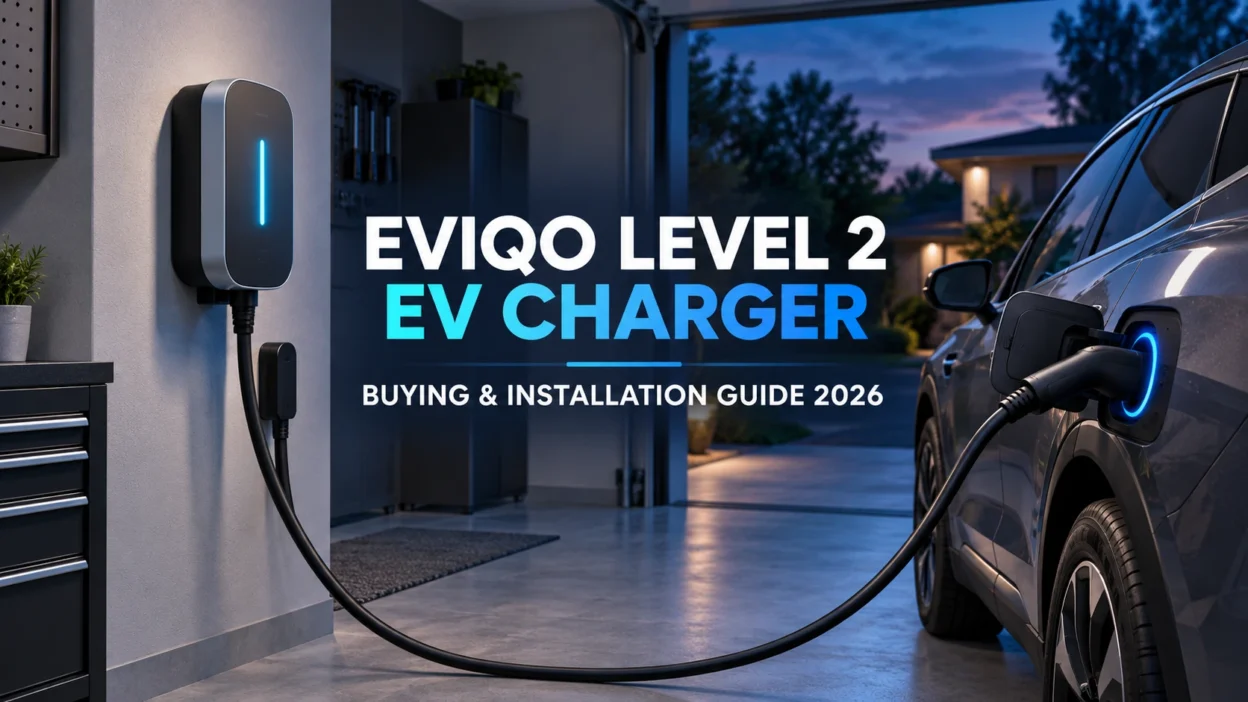
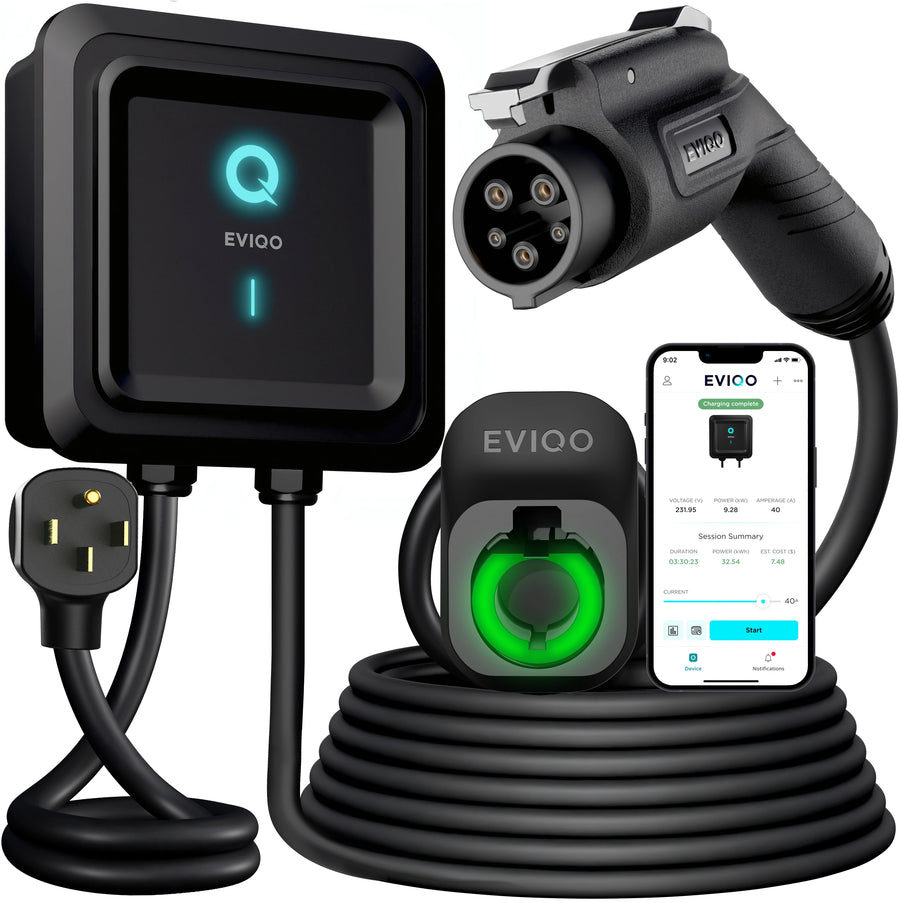
The EVIQO EVIPOWER is a wall-mounted Level 2 charging station designed for home use. The Amazon listing shared for this guide is the 240-volt, 40-amp plug-in model with a NEMA 14-50 plug, J1772 connector, Wi-Fi controls and a 25-foot charging cable.
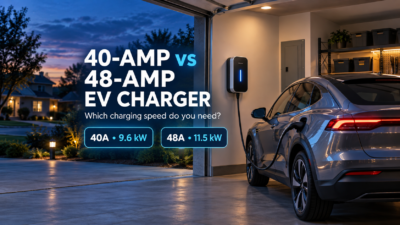
At its maximum setting, 240 volts multiplied by 40 amps equals 9,600 watts, or 9.6 kW. That is substantially faster than charging from an ordinary 120-volt household outlet, although the actual rate is limited by the vehicle’s onboard charger, the circuit and environmental conditions.
EVIQO also sells hardwired and NACS versions. These are not interchangeable buying decisions. The plug-in model is intended for a NEMA 14-50 circuit and should normally be limited to 40 amps. Reaching 48 amps requires a hardwired installation on a suitably sized dedicated circuit.
EVIQO 40A specifications at a glance
| Feature | Specification |
|---|---|
| Charging type | Level 2 AC home charger |
| Input | 240V |
| Maximum output | 40A / 9.6 kW for the plug-in model |
| Power connection | NEMA 14-50 plug |
| Vehicle connector | J1772 on the referenced model |
| Charging cable | 25 feet |
| Connectivity | 2.4 GHz Wi-Fi and EVIQO app |
| Outdoor protection | Manufacturer states IP66 / NEMA 4 |
| Warranty | Three years according to EVIQO |
| Installation | Dedicated 240V circuit; professional assessment recommended |
These details should be checked against the exact Amazon variation before ordering because EVIQO sells plug-in, hardwired, J1772 and NACS configurations under similar product names.
How fast can it charge an EV?
A 40-amp Level 2 charger can supply up to 9.6 kW. If an EV accepts the full rate, one hour of charging adds roughly 9.6 kWh before normal charging losses. The number of driving miles added varies widely by vehicle efficiency.
For example, an efficient EV using about 0.28 kWh per mile could theoretically gain around 30 miles of usable range per hour after allowing for losses. A larger truck or SUV consuming closer to 0.45 kWh per mile would gain fewer miles from the same energy.
The charger cannot force a vehicle to accept 9.6 kW. If the onboard AC charger is limited to 7.2 kW, the car will charge at approximately that lower rate. Check the vehicle manual before paying for more circuit capacity than the car can use.
Plug-in 40A versus hardwired 48A
| Setup | Typical circuit | Maximum charging output | Best suited to |
|---|---|---|---|
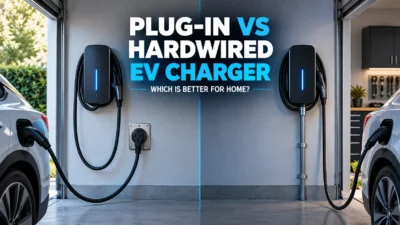
| 40A plug-in | 50A dedicated circuit with NEMA 14-50 | 9.6 kW | People who already have a suitable outlet or may move the charger |
| 48A hardwired | 60A dedicated circuit | 11.5 kW | Homeowners wanting a permanent installation and maximum supported speed |
EV charging is a continuous electrical load, so the usable charging current is normally limited to 80% of the circuit rating. That is why a 50-amp circuit supports 40-amp continuous charging and a 60-amp circuit supports 48 amps.
Do not select 48 amps in an app simply because the charger offers the option. The breaker, conductor size, connection method, panel capacity and local code must all support it. A licensed electrician should determine the safe setting.
App and smart-charging features
The EVIQO mobile app provides charging controls and usage information. According to its current app listing, users can start or stop charging, adjust allowed amperage, build schedules, delay a session, enter electricity-rate periods and review charging statistics.
These functions are useful when a utility offers lower overnight rates. Instead of remembering to plug in at a particular time, the owner can connect the car after arriving home and schedule charging for the cheaper period.
The unit uses 2.4 GHz Wi-Fi. That frequency usually provides better range through garage walls than 5 GHz, but setup may be inconvenient if a router combines both bands or the garage has weak coverage. Basic charging should not depend on constant internet access, but smart controls and remote reporting require a reliable connection.
Vehicle compatibility
The referenced Amazon model uses a J1772 connector. It is suitable for many non-Tesla EVs and plug-in hybrids that have a J1772 AC inlet. A Tesla can generally use a J1772 charger with the appropriate adapter.
Connector standards are changing in North America. Many newer vehicles are moving toward NACS. Before ordering, check the charge port on the exact vehicle and decide whether using an adapter is acceptable. EVIQO also offers native NACS versions, which may be a cleaner choice for Tesla owners and some newer EV models.
Installation requirements and safety
A Level 2 charger is a large continuous household load. Even the plug-in version is not comparable to connecting a small appliance to an ordinary outlet.
- Use a dedicated 240V circuit sized for the chosen charging current.
- Have the electrical panel’s available capacity checked.
- Use a high-quality receptacle designed for repeated, sustained EV charging.
- Follow local requirements for breaker type, permits and inspections.
- Mount the charger where its cable reaches the vehicle without being stretched or creating a trip hazard.
- Do not use an extension cord or a light-duty adapter.
If there is no existing EV-ready circuit, arrange an assessment by a licensed electrician. The cost depends on panel capacity, cable distance, wall construction, trenching and permit requirements. A plug-in charger is not automatically a do-it-yourself installation when a new high-current outlet is required.
EVIQO states that its chargers carry ETL, FCC and ENERGY STAR credentials and comply with relevant UL requirements. Buyers should confirm the certification marks and model number on the exact unit received, especially when purchasing through a marketplace listing.
What we like
- Useful charging power: Up to 9.6 kW is enough for overnight charging for many EV owners.
- Long cable: A 25-foot output cable provides flexibility when the charge port is on the opposite side of the vehicle.
- Scheduling and energy tracking: The app supports off-peak charging and estimated cost monitoring.
- Outdoor-oriented enclosure: The manufacturer lists IP66 and NEMA 4 protection.
- Adjustable current: Lower amperage settings may help match an approved circuit, provided the electrician configures the installation correctly.
- Three-year warranty: This is competitive with many residential charging products.
Potential drawbacks
- Smaller ecosystem: EVIQO does not have the same installed base or long-term track record as the largest charging brands.
- Similar model names: Buyers must distinguish between 40A plug-in, 48A hardwired, J1772 and NACS versions.
- Wi-Fi limitations: Smart features rely on 2.4 GHz Wi-Fi and app support.
- No guarantee of maximum vehicle speed: Your EV’s onboard charger may accept less than 9.6 kW.
- Installation may cost more than the charger: Panel upgrades or long cable runs can substantially increase the total project cost.
- Marketplace reviews need context: High ratings can help reveal recurring themes, but they do not replace certification checks or professional electrical advice.
What Amazon demand tells us—and what it does not
The EVIQO model has strong visibility on Amazon, and EVIQO currently promotes its product as an Amazon best seller. That makes it worth researching because many shoppers are actively considering it.
However, an Amazon badge or sales rank can change by category, location and time. It should be treated as a product-discovery signal rather than proof that the charger is the safest or best choice for every home. When reading reviews, look for repeated patterns involving app stability, cable flexibility, cold-weather use, installation clarity and customer support. Give more weight to detailed reviews that identify the vehicle, circuit and length of ownership.
View the referenced EVIQO charger on Amazon. Price and availability may change.
Who should consider this charger?
The 40A plug-in EVIQO makes the most sense for a driver who has, or plans to install, a properly rated NEMA 14-50 circuit and wants smart scheduling without paying only for brand recognition. It is also convenient for someone who may want to unplug and relocate the charger later.
Choose the hardwired version instead when maximum charging speed, permanent outdoor installation or eliminating the receptacle connection is more important. Consider a larger established brand if long-term app support, broad utility integration or a mature service network matters more than the initial purchase price.
How to decide before buying
- Check the vehicle connector. Confirm whether you need J1772, NACS or an adapter.
- Check the onboard charging limit. A car capped at 7.2 kW cannot use the full 9.6 kW output.
- Inspect panel capacity. An electrician may recommend load management or a service upgrade.
- Choose plug-in or hardwired. Do this before ordering because current EVIQO versions may not be field-convertible.
- Confirm the exact certification label. Match the model on the listing, packaging and product label.
- Compare total installed cost. Include the charger, wiring, breaker, receptacle or junction box, permits and labor.
Tracking household electricity use can also help you understand the effect of EV charging on your overall demand. Our guide to the best home energy monitors explains the main monitoring options. If you are also planning outage protection, learn how to measure essential loads before buying a backup battery.
Is the EVIQO Level 2 charger worth it?
The EVIQO 40A plug-in charger offers a useful combination of 9.6 kW charging, a 25-foot cable, smart scheduling and weather-resistant construction. It appears competitive for buyers who want more than a basic portable charging cable but do not automatically need a premium networked charger.
Its strongest use case is straightforward: a compatible EV, a professionally approved 50-amp NEMA 14-50 circuit and reliable 2.4 GHz Wi-Fi. The main caution is to select the correct model and never confuse its plug-in rating with the higher output available from a hardwired installation.
Frequently asked questions
Can the EVIQO plug-in charger run at 48 amps?
A NEMA 14-50 plug-in installation is normally limited to 40 amps of continuous charging on a 50-amp circuit. Use a suitable hardwired model and circuit if 48-amp charging is required.
Does it work with Tesla vehicles?
The J1772 version can generally charge a Tesla with the appropriate adapter. EVIQO also sells native NACS versions that connect directly to compatible vehicles.
Does the charger need Wi-Fi?
Wi-Fi is needed for remote app features such as scheduling, statistics and control. The charger’s core plug-and-charge function should not require continuous internet access, but confirm offline behavior in the manual for the exact model.
Can it be installed outdoors?
EVIQO lists IP66 and NEMA 4 protection for its enclosure. Outdoor electrical work must still use code-compliant weatherproof wiring and installation methods.
Should I install a NEMA 14-50 outlet myself?
High-current EV charging can expose weak connections and undersized wiring. A licensed electrician should assess the panel, circuit, receptacle, breaker and local permit requirements.