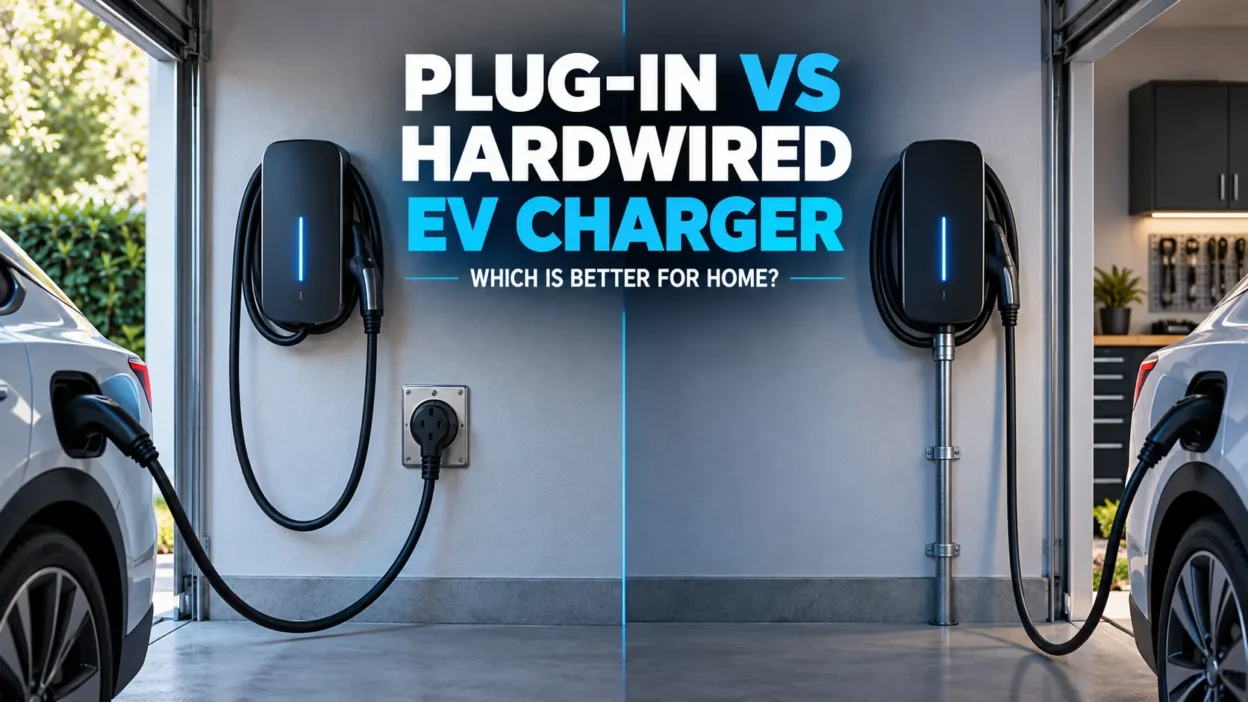
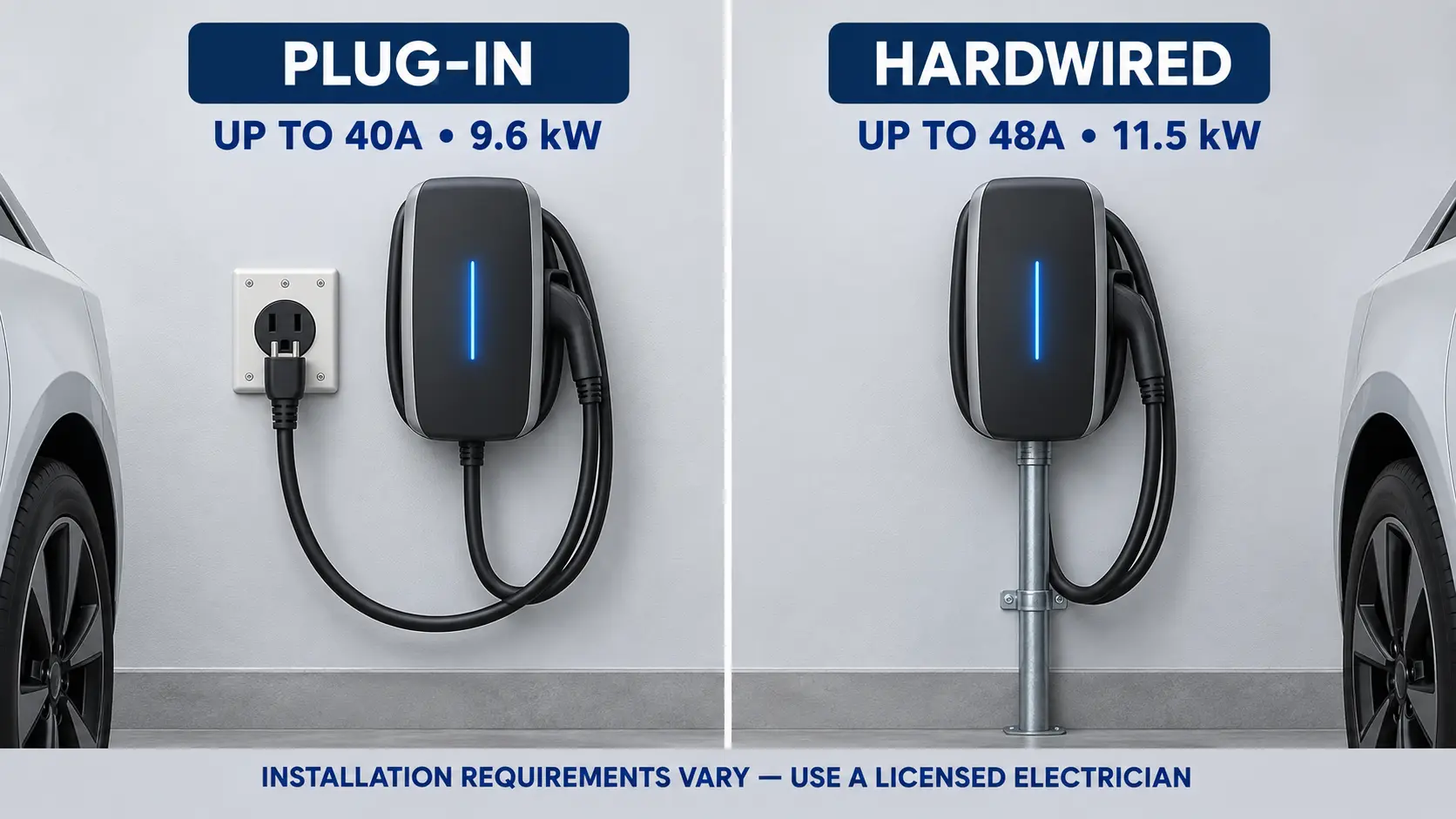
Quick answer: A hardwired EV charger is usually the better long-term choice for homeowners because it supports higher charging output, removes the plug-and-receptacle connection and is generally cleaner for outdoor installation. A plug-in charger is better when portability matters or when the home already has a professionally installed, continuous-duty NEMA 14-50 outlet.
The right option depends on your electrical panel, vehicle charging limit, parking arrangement, local code and plans for the property. Neither connection method makes an uncertified charger or an undersized circuit safe.
Safety note: Level 2 EV charging is a high-power continuous electrical load. New circuits, outlets and hardwired installations should be assessed and completed by a qualified electrician in accordance with the charger instructions and local requirements.
Plug-in vs hardwired EV charger at a glance
| Factor | Plug-in EV charger | Hardwired EV charger |
|---|---|---|
| Typical maximum output | 40A / 9.6 kW on a 50A NEMA 14-50 circuit | Commonly 48A / 11.5 kW on a 60A circuit; some models support more |
| Connection | Plugs into a compatible 240V receptacle | Connected directly to the branch circuit |
| Portability | Easier to unplug and move | Permanent installation |
| Potential heat points | Includes plug and receptacle contacts | No plug or receptacle connection |
| Outdoor suitability | Possible with suitable equipment and weatherproof installation | Usually the cleaner outdoor choice |
| Initial convenience | Convenient if a compliant outlet already exists | Requires professional connection |
| Best for | Renters, movers and existing EV-ready outlets | Homeowners and permanent daily charging |
What is a plug-in EV charger?
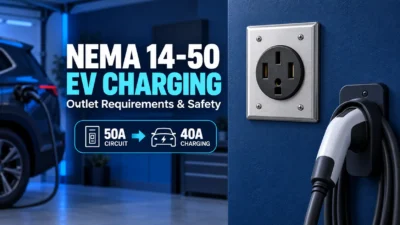
A plug-in Level 2 charger has an input cable that connects to a 240-volt receptacle. NEMA 14-50 is the most common option for home EV charging, although some chargers use NEMA 6-50 or other plug types.
The charger is removable without disconnecting fixed wiring. That can be useful if you rent, expect to move or want to replace the charger easily. However, the outlet, breaker, conductors and enclosure must all be appropriate for sustained charging.
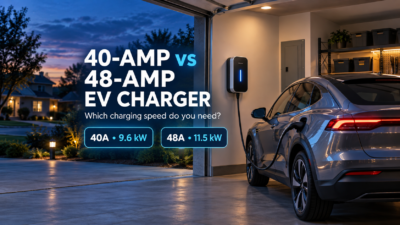
A NEMA 14-50 receptacle is rated at 50 amps, but EV charging is a continuous load. A plug-in charger on that circuit is therefore normally limited to 40 amps. At 240 volts, that provides up to 9.6 kW before normal charging losses and vehicle limitations.
What is a hardwired EV charger?
A hardwired charger connects directly to a dedicated branch circuit. There is no plug or wall receptacle between the electrical supply and charging equipment.
Many residential hardwired chargers support 48 amps on a suitably designed 60-amp circuit, providing up to 11.5 kW. Some current products reach 50 amps or more, but their circuits must be designed according to the manufacturer’s instructions and local electrical code.
Hardwiring does not mean the charger can be installed anywhere or set to any amperage. The electrician still needs to evaluate panel capacity, conductor sizing, breaker requirements, cable routing, mounting location and permitted output.
Charging-speed difference
| Charging current | Approximate power at 240V | Energy supplied in eight hours* |
|---|---|---|
| 32A | 7.7 kW | About 61 kWh |
| 40A | 9.6 kW | About 77 kWh |
| 48A | 11.5 kW | About 92 kWh |
*Simple output calculation before charging losses, battery tapering and vehicle limits.
Moving from 40 to 48 amps increases theoretical charging power by about 20%. That difference can matter for electric trucks, large SUVs, long daily travel or a short off-peak electricity window.
Many drivers will not notice a practical difference. A 40-amp charger can add far more energy overnight than a typical commute uses. The vehicle may also be unable to accept 11.5 kW through its onboard AC charger. Check the vehicle specification before paying for a larger circuit.
Safety: why the connection method matters
A plug-in charger adds two electrical contact interfaces: the charger plug and wall receptacle. Loose terminals, worn contacts, frequent unplugging or a receptacle not designed for sustained high-current use can create heat.
Emporia’s current installation guidance specifically warns that not every NEMA 14-50 outlet is suitable for daily EV charging and recommends an industrial-grade, continuous-duty receptacle. Other manufacturers provide similar installation requirements.
A hardwired installation removes the receptacle and plug as potential failure points. It still depends on correct conductor sizing, torque, overcurrent protection and workmanship, so hardwired should not be interpreted as automatically safe without professional installation.
GFCI requirements and nuisance tripping
Plug-in EV charging can create an installation complication because local rules may require GFCI protection for the receptacle, while the charger also contains internal ground-fault protection. In some combinations, this can contribute to nuisance tripping.
Hardwired EV charging equipment with integrated protection may be treated differently, depending on the equipment listing and locally adopted code. Requirements change by jurisdiction, so this is a question for the electrician and local authority—not something to solve by bypassing protection.
Never replace a required protective breaker or alter the charger’s safety configuration simply to stop it from tripping. The underlying circuit, equipment and code requirements must be checked first.
Installation cost
If a suitable outlet already exists in the right location, a plug-in charger can reduce immediate installation work. But an old range or recreational-vehicle outlet should not automatically be assumed suitable for repeated EV charging.
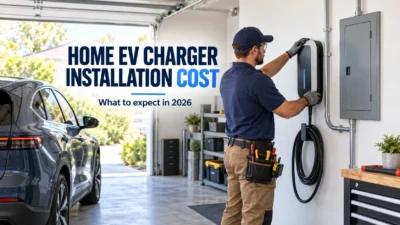
When a completely new circuit is needed, the cost difference between installing a high-quality receptacle and hardwiring may be relatively small compared with the total cost of cable, conduit, labor, permitting and possible panel work.
The U.S. Alternative Fuels Data Center notes that installation cost varies with wiring distance, trenching, electrical upgrades, labor and permits. The shortest practical route from the panel to the parking position usually reduces cost.
Common cost factors
- Distance between the electrical panel and charger
- Finished walls, crawlspaces or concrete that complicate cable routing
- Indoor versus outdoor installation
- Panel capacity and available breaker spaces
- Load-management equipment
- Service or panel upgrades
- Permit and inspection charges
- Receptacle, weatherproof enclosure and GFCI requirements
Portability and replacement
A plug-in charger can be disconnected and taken to another property, provided the new location has the correct electrical setup. This flexibility is its clearest advantage.
Hardwired equipment must be disconnected by a qualified person. Even so, a wall charger is not usually moved often, and many homeowners prefer to leave it as a useful property feature.
Plug-in does not mean frequently unplugging the charger is a good practice. Repeated cycling can wear receptacle contacts. If the charger will stay in one garage for years, hardwiring may provide more value than theoretical portability.
Which is better outdoors?
Both types can be installed outdoors when the charger, wiring method and enclosure are rated for the environment. The U.S. Alternative Fuels Data Center confirms that outdoor home charging can be safe with outdoor-rated equipment.
Hardwiring is often cleaner because there is no exposed plug-and-receptacle assembly. A plug-in outdoor installation requires an appropriate weatherproof receptacle enclosure and must follow the manufacturer’s mounting and orientation instructions.
Check the charger’s NEMA or IP enclosure rating, supported temperature range and cable-storage method. Place it where standing water, snow equipment, vehicle tires and walking traffic will not damage the cable.
Which is better for renters?
A plug-in charger is usually the more practical choice for renters, but written property-owner approval may still be required for the circuit and outlet. The electrical work belongs to the property even if the charger can move with the tenant.
Before spending money, confirm who pays for installation, who owns the outlet, whether permits are required and what must happen when the lease ends.
Which is better for homeowners?
For a homeowner installing a new dedicated circuit, hardwired is normally our recommendation. It supports higher output, removes the receptacle connection and suits permanent indoor or outdoor installation.
Plug-in remains reasonable when a suitable outlet already exists, 40-amp charging is sufficient and future portability has real value. The outlet should be inspected rather than judged only by its appearance.
When load management may help
Some homes do not have enough spare electrical capacity for a charger operating at its maximum rating. That does not always mean a costly service upgrade is the only option.
Compatible load-management systems can reduce EV charging when household demand is high and increase it when capacity becomes available. Some chargers provide this capability directly or through an additional energy-monitoring device.
Our guide to the best home energy monitors explains how household demand can be measured. Monitoring data is useful, but the electrician’s formal load calculation still controls the installation decision.
Plug-in vs hardwired: recommendations by situation
| Situation | Better starting choice | Reason |
|---|---|---|
| New permanent installation | Hardwired | Cleaner connection and higher-output potential |
| Existing inspected NEMA 14-50 outlet | Plug-in | Can avoid unnecessary rewiring |
| Rental property | Plug-in | Charger can move after approved electrical work |
| 48A charging required | Hardwired | Typically needs a 60A dedicated circuit |
| Outdoor driveway | Hardwired | Fewer exposed connection components |
| Frequent relocation | Plug-in | Easier equipment removal |
| Limited panel capacity | Either, with reduced current or load management | Connection method alone does not create capacity |
Products that illustrate the difference
The EVIQO 40A plug-in charger is a practical example of a NEMA 14-50 smart charger. It delivers up to 9.6 kW and is designed for buyers who want portability and app controls.
Our comparison of the best Level 2 home EV chargers includes both connection types. Products such as the Emporia Classic are sold in plug-in and hardwired configurations, while the Tesla Universal Wall Connector is designed for hardwired installation.
Final verdict
Choose hardwired when you own the property, are installing a new circuit and expect the charger to remain in place. It provides the cleanest route to 48-amp charging and removes the outlet connection from a demanding continuous load.
Choose plug-in when you already have a properly rated and inspected outlet, 40 amps meets your needs, or taking the charger with you is genuinely important. Do not select plug-in simply because it appears to avoid an electrician; installing or verifying the circuit is the most important part of the project.
Frequently asked questions
Is a hardwired EV charger safer than a plug-in charger?
A properly installed version of either type can be safe. Hardwiring removes the plug and receptacle as possible heat or wear points, which is an advantage for a permanent high-current installation.
Can a plug-in EV charger deliver 48 amps?
A NEMA 14-50 plug-in charger is normally limited to 40 amps on a 50-amp circuit. A 48-amp charger is typically hardwired to a properly designed 60-amp circuit.
Can I hardwire a plug-in charger later?
Some charger models support conversion, while others are sold as separate plug-in and hardwired versions. Follow the exact model’s installation instructions rather than removing its plug without manufacturer approval.
Do I need a permit for a home EV charger?
Many jurisdictions require a permit or inspection for a new 240V circuit or hardwired charger. Local rules determine the answer.
Will hardwiring make my car charge faster?
Only if the hardwired charger, circuit and vehicle support a higher rate than the plug-in setup. A car limited to 7.2 kW will not charge faster from an 11.5 kW wall unit.