Last updated: September 2026
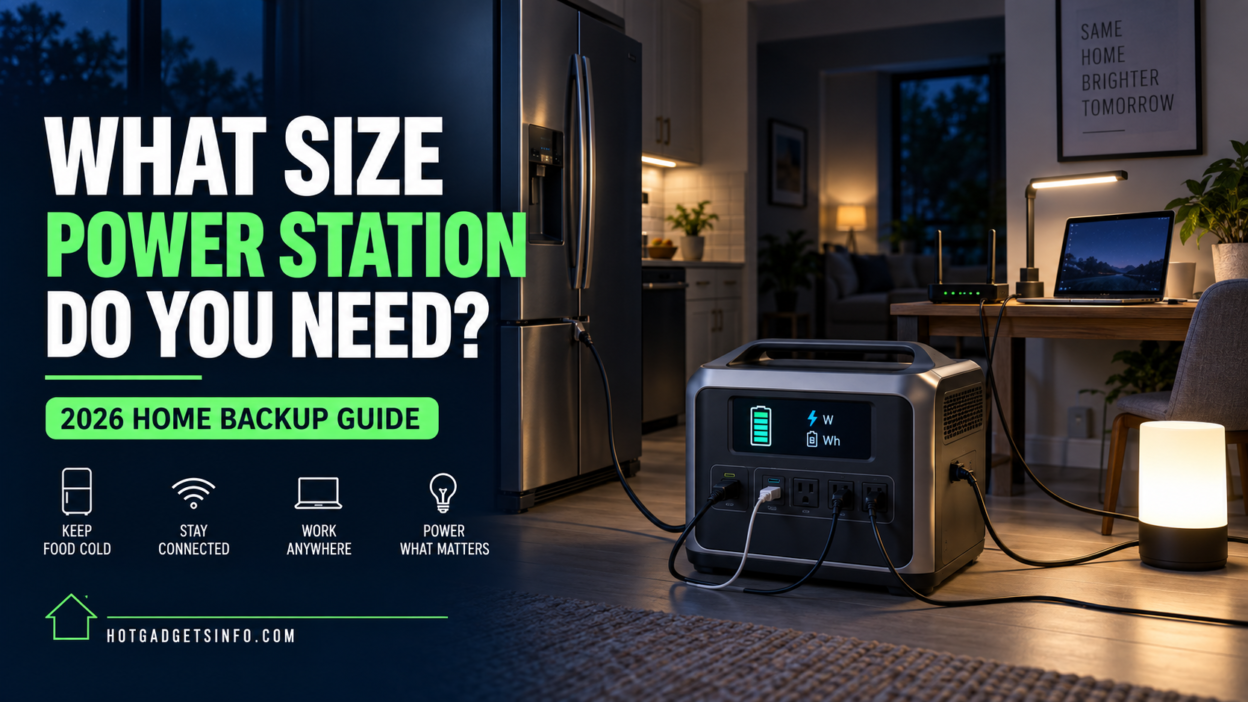
If you are asking what size portable power station you need for home backup, start with the appliances you want to keep running and how long you need them—not the size of your house. A small setup for Wi-Fi, phones and lights may need only a few hundred watt-hours. A refrigerator, home office and other essentials can push the requirement toward 1,000–2,000Wh or more.
The right unit must pass two separate tests: it needs enough output power in watts (W) to start and run your equipment, and enough battery capacity in watt-hours (Wh) to keep it operating for the required time. This guide shows you how to estimate both before comparing products.
Quick answer: What size portable power station do I need?
For phone charging, Wi-Fi and a few LED lights, a 300–500Wh unit may be sufficient for a short outage. A 1,000Wh-class power station is a more practical starting point for a refrigerator or a modest home-office setup. If you want to cover several essential appliances overnight, you may need 2,000Wh or more, possibly with an expandable battery.
These are planning ranges, not guarantees. Actual runtime depends on appliance cycling, inverter efficiency, the battery reserve, ambient temperature and the station’s own power consumption.
| Backup goal | Starting capacity range | Output to check |
|---|---|---|
| Phones, router and LED lights | 300–500Wh | 300–600W may be enough |
| Laptop, monitor, router and lights | 500–1,000Wh | 600–1,000W |
| Refrigerator plus small essentials | 1,000–2,000Wh | Check compressor startup surge |
| Several essential appliances overnight | 2,000Wh or more | 2,000W+ may be appropriate |
| Large HVAC, electric cooking or whole-home loads | Portable unit may not be the right solution | Consider an installed system |
The ranges above are deliberately broad. Measure your own equipment before purchasing.
First, understand watts and watt-hours
Watts measure power. They tell you how much electricity an appliance needs at a particular moment. The power station’s continuous AC output must be higher than the combined running load.
Watt-hours measure energy. They tell you how much energy the battery stores. A 1,000Wh battery does not mean the station can run a 1,000W appliance for exactly one hour because conversion losses and operating reserves reduce the energy available at the outlet.
EcoFlow’s current explanation uses the basic relationship:
Estimated runtime = battery capacity in Wh ÷ device power in W
That is the theoretical starting point. EcoFlow also notes that inverter efficiency commonly reduces AC energy delivery. BLUETTI’s sizing guidance similarly recommends allowing for losses rather than treating the number printed on the battery as fully available output.
Sources: EcoFlow watt and watt-hour guide and BLUETTI portable power station sizing guide.
Step 1: Decide what must stay powered
Write a short essentials list. Do not begin by trying to run everything in the house.
- Refrigerator or freezer
- Wi-Fi router and modem
- Phones and tablets
- Laptop and monitor
- LED lighting
- Television or radio
- Fan
- Medical equipment, following the equipment manufacturer’s backup guidance
Heating elements and large motors change the calculation quickly. Electric kettles, space heaters, hair dryers, ovens, clothes dryers, well pumps and air conditioners can require far more output than small electronics.
Step 2: Find the running watts
Check the product label, manual or manufacturer specification. If the label shows volts and amps but not watts, use:
Watts = volts × amps
For appliances that cycle on and off, such as refrigerators, the rated running wattage should not automatically be multiplied by 24 hours. Measuring consumption over a full day with a suitable energy meter gives a more useful figure.
Our refrigerator battery-backup guide explains why compressor cycling and startup power must be considered separately.
Step 3: Calculate the energy you need
For each device, multiply its average power by the number of hours you expect to use it:
Energy required (Wh) = average watts × hours of use
Then add the results.
| Example load | Average power used for example | Required time | Energy |
|---|---|---|---|
| Router and modem | 20W | 10 hours | 200Wh |
| Laptop | 50W | 6 hours | 300Wh |
| Two LED lights | 20W combined | 5 hours | 100Wh |
| Phone charging | 15W | 2 hours | 30Wh |
| Total | 630Wh |
This example needs 630Wh delivered to the devices. It does not mean that a 630Wh power station is sufficient.
Step 4: Allow for conversion losses and reserve
Portable power stations store DC energy, while most household appliances use AC. The inverter consumes some energy during conversion. The station may also shut down before every advertised watt-hour is delivered.
A simple planning calculation is:
Required battery capacity = device energy ÷ assumed usable efficiency
Using an 85% planning factor for the 630Wh example:
630Wh ÷ 0.85 = approximately 741Wh
A buyer could therefore compare units around 800Wh or above, then check the manufacturer’s usable-capacity information and leave additional headroom if the outage duration is uncertain. The 85% factor is an estimate, not a promise about every model.
Step 5: Check continuous output and startup surge
Capacity alone does not tell you whether an appliance will start. A power station can contain plenty of energy but still shut down if the connected load demands more watts than its inverter can provide.
Check three figures:
- Continuous AC output: what the unit can supply normally
- Surge or peak output: short-duration power available when a motor starts
- Combined load: the total power required when several devices operate together
A refrigerator compressor, pump or power tool may briefly need more power at startup than while running. Confirm the appliance requirement and the power station’s surge rules instead of relying on a generic multiplier.
Worked example: refrigerator and basic home office
Suppose your measured or estimated outage energy is:
- Refrigerator: 1,200Wh per day
- Router and modem: 240Wh per day
- Laptop: 300Wh per workday
- Lighting and phone charging: 160Wh
Total estimated energy:
1,200 + 240 + 300 + 160 = 1,900Wh
After allowing for 85% usable efficiency:
1,900Wh ÷ 0.85 = approximately 2,235Wh
For this example, a 2,000Wh advertised battery could be tight for a full day. A system above roughly 2,200Wh, or an expandable model with a clear recharge plan, would provide more realistic headroom. You would still need to verify that its inverter can start the refrigerator and support the maximum combined load.
Should you choose 500Wh, 1,000Wh or 2,000Wh?
Choose around 300–500Wh when:
- You mainly need phones, Wi-Fi and lights
- The outage is expected to be short
- Low weight and easy storage matter most
- You do not plan to run a full-size refrigerator for long
Choose around 1,000Wh when:
- You need a practical middle ground
- You want to support a laptop, router, lights and selected small appliances
- You may run a refrigerator for part of an outage
- You still need the unit to be movable by one person
Choose around 2,000Wh or more when:
- You want overnight essential-load backup
- You are combining refrigeration with a home office and lighting
- You expect longer outages
- You want expansion-battery or higher solar-input options
For much larger loads, compare portable systems with an installed battery using our home solar battery guide. An installed system may be more appropriate when you want automatic backup for household circuits rather than extension cords running to selected devices.
Do solar panels change the required battery size?
Solar charging can extend runtime, but it should not be treated as guaranteed energy. Panel rating, weather, shade, season, orientation and the station’s solar-input limit all affect recharge performance.
Check:
- Maximum solar-input watts
- Supported voltage and current range
- Connector compatibility
- Whether solar charging and output can operate together
- Realistic daylight available during the outage
A large battery paired with too little solar input may not recharge before the next night. Conversely, an oversized solar array cannot force more power into a station than its input controller accepts.
Other features that matter for home backup
- Battery chemistry: many current units use lithium iron phosphate, commonly written as LiFePO4 or LFP.
- Recharge speed: fast wall charging helps restore the battery between outages.
- UPS or EPS mode: confirm the transfer time and equipment compatibility if devices must remain connected.
- Expandable capacity: useful when your initial budget is limited but future runtime may increase.
- Weight and wheels: a high-capacity unit is not meaningfully portable if nobody in the household can move it safely.
- Warranty and service: compare the written warranty and local support, not only battery-cycle advertising.
- Indoor placement: follow the manufacturer’s temperature, ventilation, clearance and charging instructions.
Common sizing mistakes
- Confusing watts with watt-hours
- Calculating from house size instead of actual loads
- Ignoring refrigerator or pump startup power
- Treating advertised capacity as fully usable AC energy
- Assuming solar panels always produce their rated output
- Buying too many outlets but not enough inverter output
- Planning to run resistance heating from a small battery
- Depending on an untested setup during an emergency
A simple checklist before buying
- List the devices that genuinely need backup.
- Record their average running watts and startup requirements.
- Estimate how many hours each device will operate.
- Add the required watt-hours.
- Allow for conversion losses and a sensible reserve.
- Check continuous and surge output.
- Confirm wall and solar recharge options.
- Check weight, warranty and indoor-use instructions.
- Test the complete setup before relying on it.
Frequently asked questions
Is a 1,000Wh portable power station enough for home backup?
It can be enough for selected essentials, but not usually for unrestricted whole-home use. Add the energy required by your devices and check whether the inverter can support their combined running and startup power.
Can a portable power station run a refrigerator?
Many can, provided the station has sufficient continuous output, startup-surge capability and battery capacity. Daily refrigerator energy use matters more than running watts alone when estimating runtime.
What is the difference between 1,000W and 1,000Wh?
1,000W describes power output. 1,000Wh describes stored energy. A station may have a 1,000Wh battery and an inverter rated above or below 1,000W, so both specifications must be checked.
Should I buy a larger power station than my calculation?
Some headroom is sensible because loads change and published capacity does not translate perfectly into AC energy at the outlet. Avoid blindly oversizing, though; larger units cost more and are harder to move.
Can a portable power station replace a home battery?
It can provide useful plug-in backup for selected devices. It does not automatically replace a professionally installed battery connected to household circuits. Our home battery sizing guide explains the installed-system side of the decision.
The bottom line
The right portable power station is not the model with the largest number on the box. Calculate the watt-hours your essential devices need, allow for conversion losses, and then make sure the inverter can support both continuous load and startup surge.
For a short outage covering Wi-Fi, phones and lights, a few hundred watt-hours may be enough. A refrigerator or home-office setup often moves the practical starting point toward the 1,000Wh class, while several essentials overnight can require 2,000Wh or more. Measure your own loads and test the setup before an emergency.