Last updated: October 2026 · Prices checked on the Emporia and Refoss stores
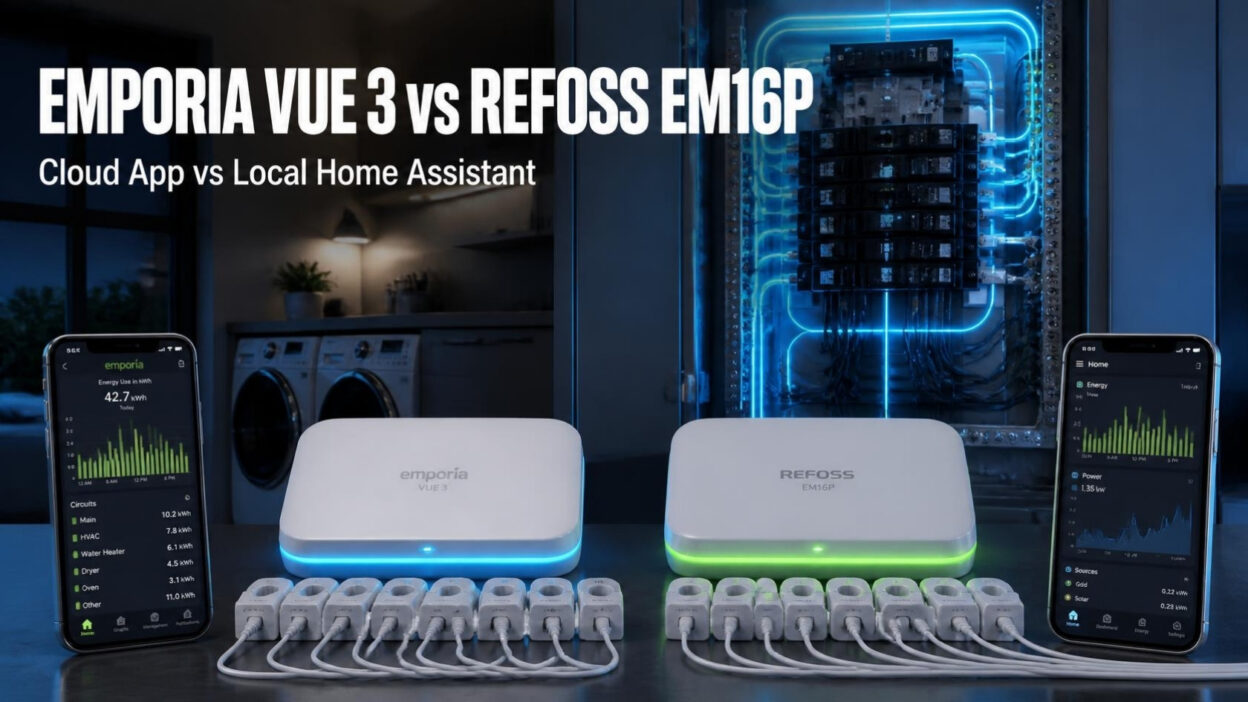
The Emporia Vue 3 and Refoss EM16P are now the two most common circuit-level home energy monitors in the $160–$200 range. Both clamp onto your main feeds and 16 individual breakers, both track solar, and both cost about the same. The real difference is where your data lives: Emporia runs through its cloud and polished app, while Refoss works locally and talks directly to Home Assistant.
How we compared them: This is a research-based comparison built from manufacturer specifications, warranty documents and Home Assistant community reports. We haven’t run a side-by-side bench test. Where a spec is only listed by a third-party site, we say so.
Emporia Vue 3 vs Refoss EM16P at a glance
| Feature | Emporia Vue 3 (16 sensors) | Refoss EM16P |
|---|---|---|
| Price (Oct 2026) | $199.99 | $159.99 sale / $199.99 regular |
| Branch-circuit sensors included | 16 × 50A | 16 × 60A |
| Main sensors | Up to 3 × 200A | 2 × 200A |
| Electrical systems | Single-phase, split-phase, three-phase wye | Split-phase and three-phase (per spec listings) |
| Connection | 2.4 GHz Wi-Fi + Ethernet | 2.4 GHz Wi-Fi + Bluetooth |
| Works without internet | No — Emporia says it needs internet and has no local storage | Yes — local web interface, runs without the cloud |
| Local API / MQTT | No official local API | Open API (JSON-RPC over HTTP), MQTT, webhooks |
| Home Assistant | Community cloud integration (HACS) | Native, no flashing required |
| Solar monitoring | Yes | Yes, including feed-in tracking |
| Stated accuracy | Not stated on product page | Within ±2% |
| Safety listing | UL 61010, UL 2808 | ETL listed to UL 61010 |
| Warranty | 1 year | Not stated on product page (check before buying) |
| Best for | Easiest setup and app | Home Assistant and local data |
Price and what’s in the box
On paper this is close to a tie. The Vue 3 with 16 sensors lists at $199.99. Refoss lists the EM16P at $199.99 but has sold it at $159.99 on its own store, and Refoss’s 16-sensor monitors regularly appear on deal sites at about $150–$170.
The Refoss kit includes 60A branch sensors, slightly higher than Emporia’s 50A clamps. In practice, a 50A clamp already covers most residential branch circuits, including a 50A EV charger or range circuit. The difference only matters if you plan to clamp a 60A circuit, such as a 48A hardwired EV charger. See our 40-amp vs 48-amp EV charger guide for why those circuits are sized at 60 amps.
Cloud vs local: the difference that matters most
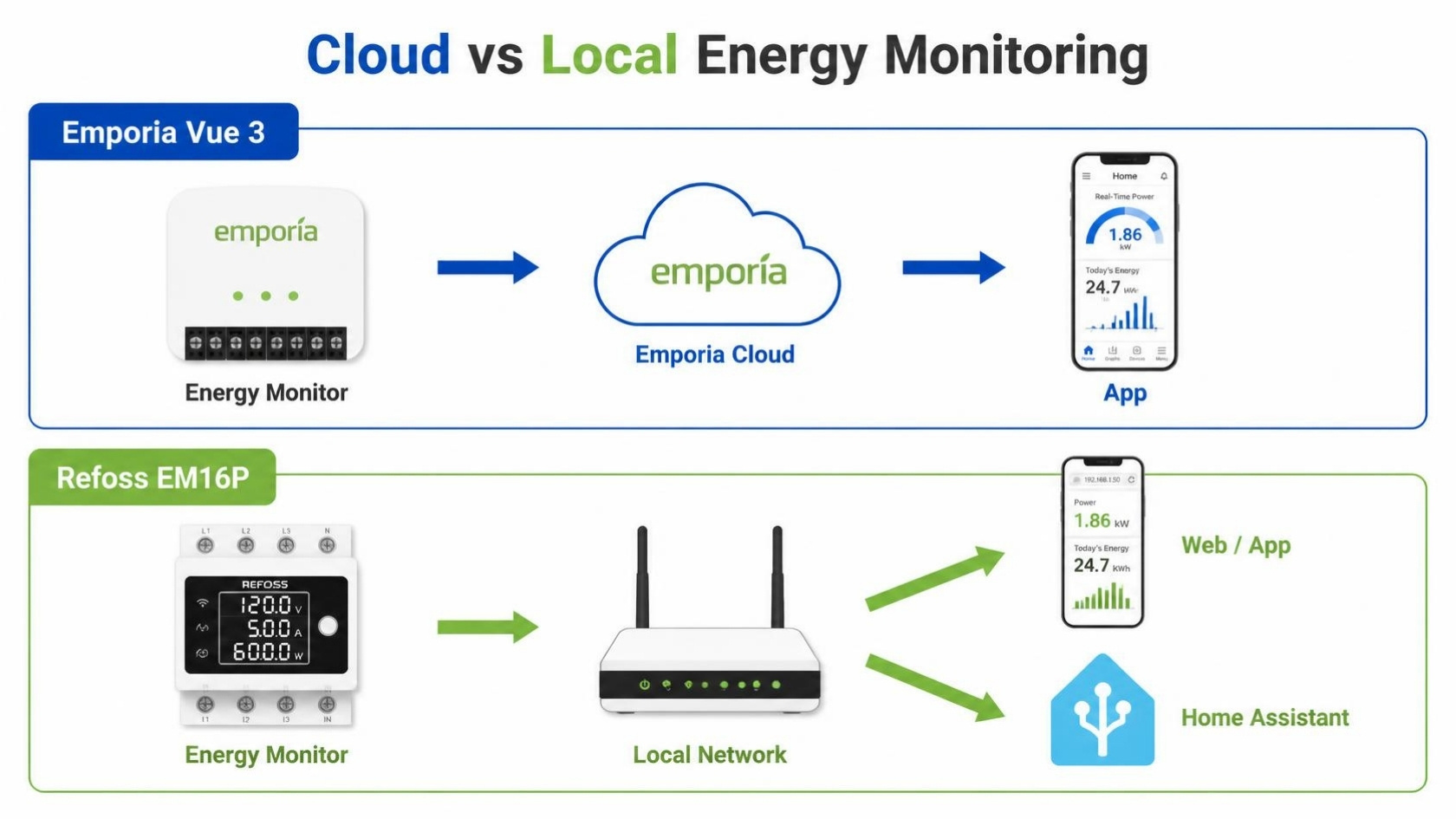
Emporia Vue 3: cloud-first
Emporia’s product page is direct about this: the Vue 3 doesn’t store data locally and requires an internet connection. Readings go to Emporia’s servers and come back to you in the app, which shows every second of usage and minute, hour and day history.
That makes setup simple and remote viewing effortless. The trade-off is dependence: if your internet drops, the Vue stops recording, and if Emporia ever changes its service, your monitor changes with it. Home Assistant users report that the official Emporia team has shown little interest in adding a local API.
Refoss EM16P: local-first
Refoss built the EM16P around the opposite idea. It can run without the app, without registration and without the cloud, through a local web interface. For integrations it offers an open API, MQTT and webhooks, and it connects natively to Home Assistant without flashing new firmware, so the warranty stays intact.
If you do use the Refoss cloud, it stores daily data for up to five years and offers hourly and minute-level exports. Third-party spec listings report about seven days of minute data stored on the device itself, which helps cover an internet outage.
Why this matters in 2026: Sense, once the most popular smart energy monitor, stopped selling its hardware at the end of 2025. Owners are still supported, but it showed that cloud-dependent devices can change direction. If long-term independence matters to you, that is a point in Refoss’s favor.
Home Assistant
This is where the two differ most.
- Refoss EM16P is the easier choice. Native support means it appears in Home Assistant without custom firmware, and data flows locally. You can feed it straight into the Energy dashboard and build automations, such as alerts when a circuit draws too much or zero-export solar rules.
- Emporia Vue 3 works through a community-built integration (ha-emporia-vue, installed with HACS) that reads Emporia’s cloud API. Users report the finest resolution is a one-minute average. Some owners have flashed the Vue 3 with ESPHome firmware for local control, but that is an unofficial modification you make at your own risk.
If Home Assistant is the reason you’re buying a monitor, the Refoss is the more natural fit.
App and everyday use
If you never plan to open Home Assistant, the picture flips. Emporia’s app is the more mature of the two. Comparison listings give it Google Home and Alexa integrations, and it connects to Emporia’s own smart plugs, EV chargers and batteries. That lets you run automations such as charging your EV from excess solar without any extra software.
Refoss’s app covers the essentials: real-time and historical usage, energy cost tracking, alerts and data export, plus power factor readings. Its ecosystem is smaller, and integrations beyond Home Assistant are limited.
Installation and compatibility
Both monitors install inside your electrical panel, with two large clamps on the main feeds and up to 16 small clamps on individual breakers. Both need a 2.4 GHz Wi-Fi signal at the panel. The Vue 3 can also use wired Ethernet, which is useful when the panel is in a garage or basement with weak Wi-Fi.
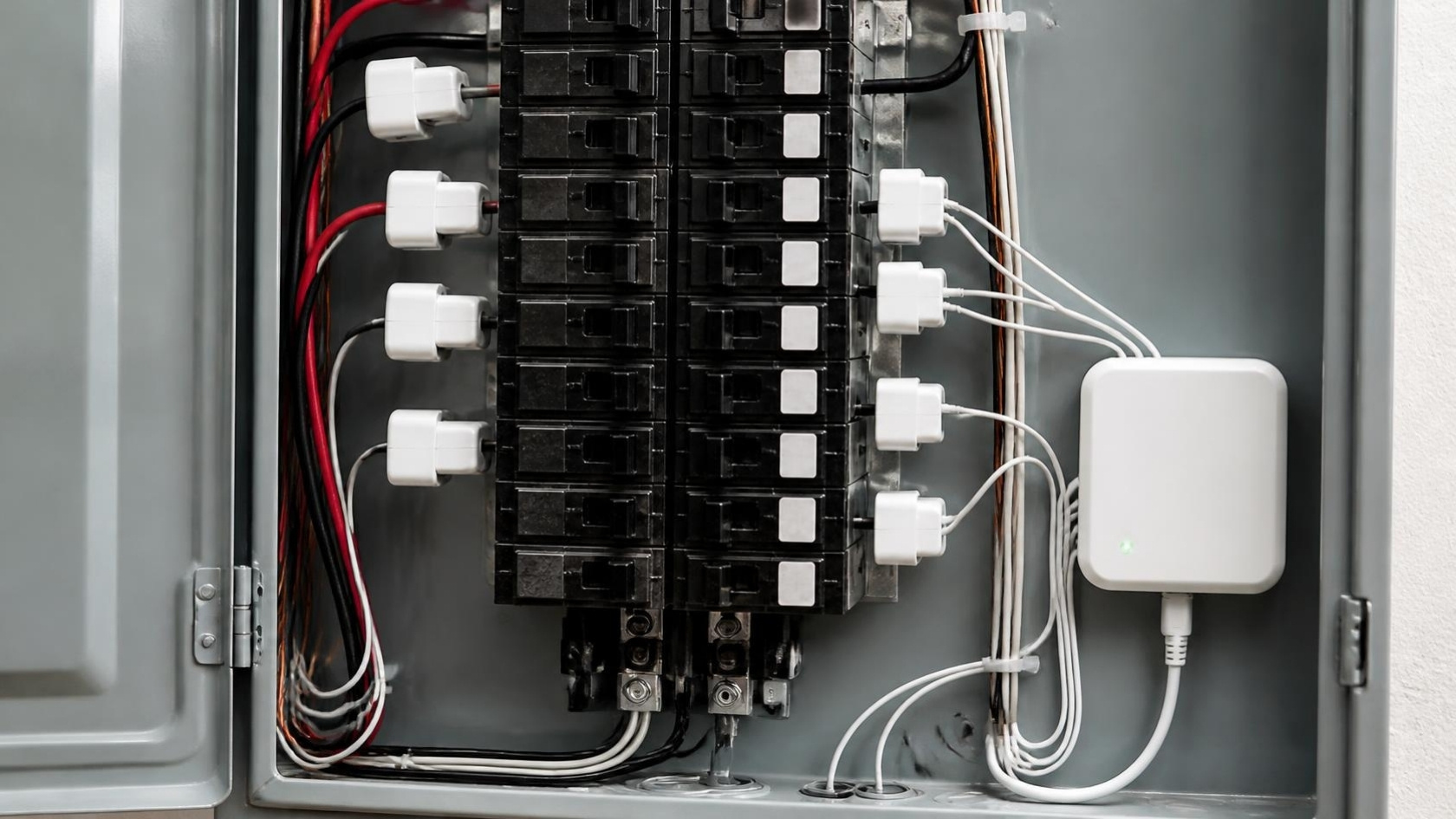
Emporia lists support for single-phase, split-phase and three-phase wye systems. Refoss’s own product page doesn’t list supported electrical systems, though third-party listings show split-phase and three-phase support. Confirm your service type with the manufacturer before ordering.
Safety: panel conductors stay live even with the main breaker off. Hire a licensed electrician unless you are trained and local rules allow you to do this work yourself.
Solar monitoring
Both monitor solar production and grid export when a sensor is placed on the inverter’s AC output and the clamps face the correct direction. Refoss also highlights zero feed-in automation through its app or Home Assistant, which is useful where exporting to the grid isn’t allowed or isn’t paid.
Either monitor gives you the measured daytime consumption and export data needed to size a battery properly. Our guide to how many solar batteries you need shows how to use that data.
Warranty and support
Emporia’s warranty page covers the Vue Gen 3 for one year from delivery. Refoss’s product page mentions a “full warranty” and a 45-day refund guarantee but doesn’t state a duration. A third-party comparison site lists two years, so ask Refoss to confirm before you buy.
Emporia is the more established brand in North America, with a longer track record and a larger owner community. Refoss is newer, which means fewer long-term reliability reports so far.
Which one should you buy?
Choose Emporia Vue 3 if:
- You want the simplest setup and the most polished app
- Your panel has weak Wi-Fi and you can run Ethernet
- You use or plan to buy Emporia’s EV charger, smart plugs or battery
- You want Alexa or Google Home integration
- You’re comfortable with your data living in the cloud
Choose Refoss EM16P if:
- You use Home Assistant or plan to
- You want data that keeps recording when the internet is down
- You want MQTT or an open API for your own dashboards
- You’d like 60A branch sensors or a lower sale price
- You’d rather not depend on one company’s cloud long term
Still deciding whether you need a circuit-level monitor at all? Our best home energy monitors guide also covers the Shelly Pro 3EM, Eyedro and simple smart plugs.
Frequently asked questions
Is Refoss EM16P better than Emporia Vue 3?
For Home Assistant and local data, yes. For ease of use, app polish and ecosystem, Emporia is stronger. Their circuit counts and prices are very similar.
Does Emporia Vue 3 work with Home Assistant?
Yes, through a community integration that reads Emporia’s cloud, typically at one-minute resolution. There is no official local API.
Does Refoss EM16P work without Wi-Fi?
It needs your local network for its web interface and Home Assistant, but it doesn’t need an internet connection or a cloud account.
Can either monitor measure a 48-amp EV charger?
A 48A charger sits on a 60A circuit. Refoss’s 60A branch sensors match that directly. With Emporia, check the current sensor options for high-amperage circuits before you buy.
Do I need an electrician to install them?
Both install inside the main panel next to live conductors. A licensed electrician is the safe choice and may be required where you live.