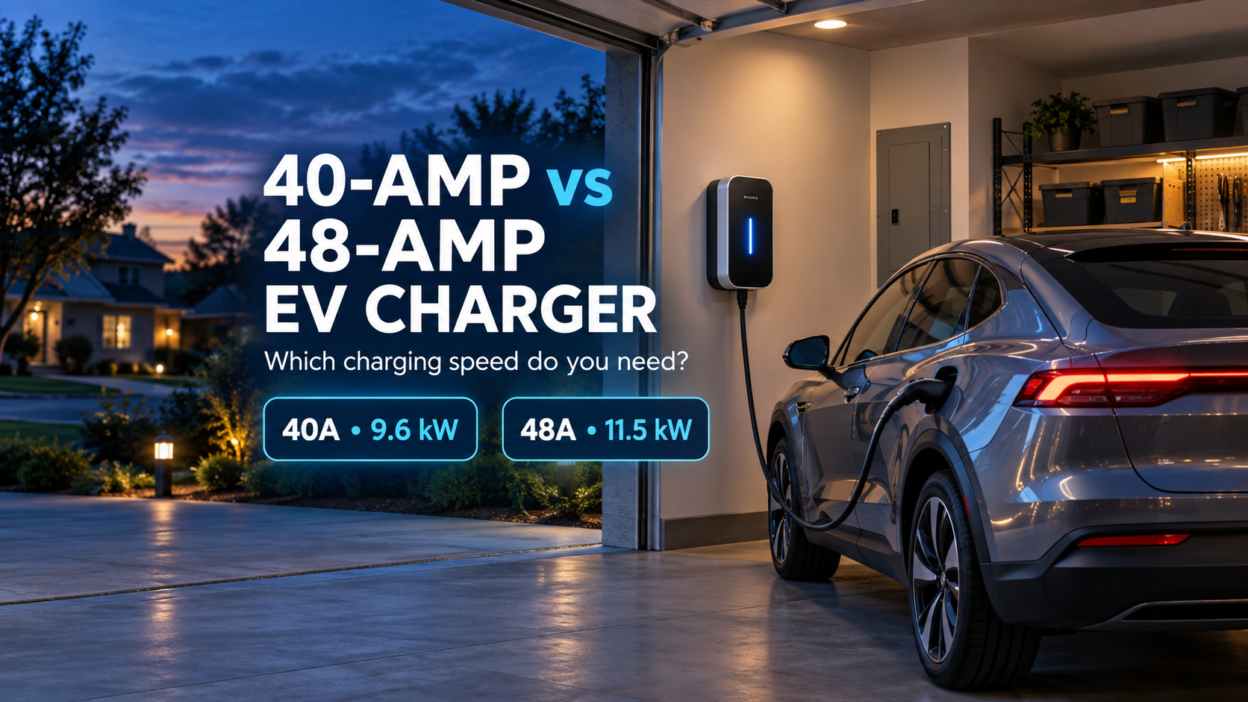
A 48-amp EV charger is faster than a 40-amp model, but the difference is smaller than the numbers can make it sound. At 240 volts, a 40-amp charger can supply about 9.6 kW. A 48-amp charger can supply about 11.5 kW. That is roughly 20% more power—not a completely different charging experience.
For many drivers, 40 amps is already enough to refill the battery overnight. A 48-amp charger becomes more useful when the vehicle can accept 48 amps, the daily mileage is high, or the charging window is short. It normally also requires a larger dedicated circuit and a hardwired installation.
This guide explains the real differences between a 40-amp vs 48-amp EV charger, including charging speed, circuit requirements, vehicle limits and installation considerations.
40-Amp vs 48-Amp EV Charger at a Glance
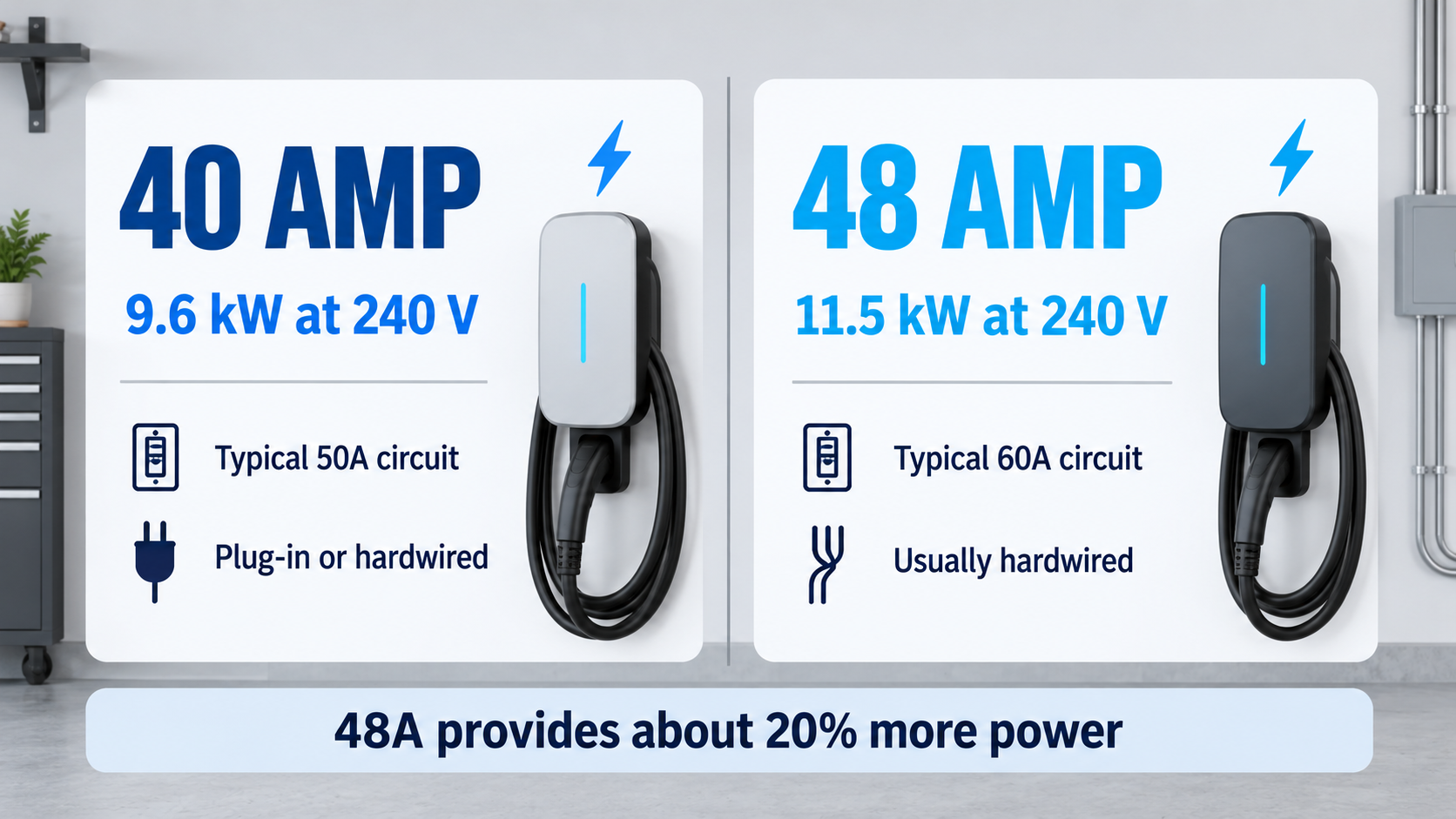
| Feature | 40-amp charger | 48-amp charger |
|---|---|---|
| Maximum power at 240 V | 9.6 kW | 11.5 kW |
| Typical dedicated circuit | 50 amps | 60 amps |
| Common connection | Plug-in or hardwired, depending on model | Normally hardwired |
| Energy added in 8 hours* | Up to 76.8 kWh | Up to 92.2 kWh |
| Best suited to | Most overnight home charging | High daily mileage or shorter charging windows |
*Theoretical charger output before vehicle, temperature and charging losses. Actual energy entering the battery will be lower and charging may slow as the battery fills.
How Much Faster Is a 48-Amp Charger?
The basic power calculation is:
Power (kW) = volts × amps ÷ 1,000
- 240 V × 40 A = 9.6 kW
- 240 V × 48 A = 11.52 kW
A 48-amp unit therefore delivers 1.92 kW more than a 40-amp unit under the same conditions. If a vehicle could hold the maximum rate continuously, the 48-amp charger would add the same amount of energy in about 17% less time.
For example, delivering 60 kWh would theoretically take about 6.25 hours at 9.6 kW and 5.2 hours at 11.5 kW. Real sessions take longer because AC-to-DC conversion is not lossless, voltage can vary, the car controls the accepted rate and charging may taper near the selected limit.
Estimated charging time by energy needed
| Energy needed | 40 A / 9.6 kW | 48 A / 11.5 kW | Approximate time saved |
|---|---|---|---|
| 20 kWh | 2 hr 5 min | 1 hr 44 min | 21 min |
| 40 kWh | 4 hr 10 min | 3 hr 29 min | 41 min |
| 60 kWh | 6 hr 15 min | 5 hr 13 min | 1 hr 2 min |
| 80 kWh | 8 hr 20 min | 6 hr 57 min | 1 hr 23 min |
These are ideal calculations, not promises for a specific car. They are most useful for comparing the two power levels.
Your Vehicle May Be the Limiting Factor
An EV charger does not force 48 amps into every vehicle. The car’s onboard AC charger decides how much power it can accept. If the vehicle is limited to 32 or 40 amps, installing a 48-amp wall unit will not make that vehicle charge faster.
Tesla’s current Wall Connector table illustrates this clearly. A 60-amp circuit can support 48-amp output, while a 50-amp circuit supports 40-amp output. However, Tesla also notes that some versions of the Model 3 and Model Y are limited to 32 amps. Always check the AC charging specification for your exact model and trim rather than relying only on the charger’s advertised maximum.
A higher-capacity charger may still offer future value if you expect to replace the vehicle, add a second EV or want to avoid upgrading the circuit later. That benefit must be weighed against the present installation cost.
Why 40 Amps Typically Uses a 50-Amp Circuit
EV charging is treated as a continuous electrical load in the United States. A common planning rule is that the charging current should not exceed 80% of the branch-circuit rating.
- 50-amp circuit × 80% = 40 amps
- 60-amp circuit × 80% = 48 amps
This is why “40-amp charger” and “50-amp circuit” are often discussed together, while 48-amp charging is usually paired with a 60-amp circuit. Tesla’s installation documentation uses the same combinations.
This article is general planning guidance, not an electrical design. Conductor size depends on factors such as terminal temperature ratings, wiring method, distance, local code and the equipment instructions. Have a qualified electrician perform a load calculation and specify the breaker, conductors, grounding and any required disconnect or protection.
Does a 48-Amp Charger Have to Be Hardwired?
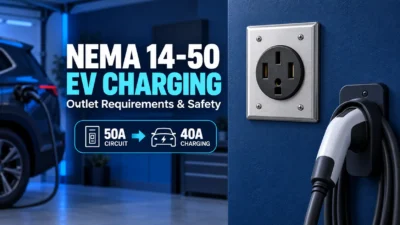
In normal North American home installations, 48-amp charging is hardwired. The familiar NEMA 14-50 receptacle is associated with a 50-amp circuit, so a plug-in charger using that outlet is commonly configured for no more than 40 amps of continuous charging.
Hardwiring removes the plug and receptacle from the power path and can support higher configured output when the charger and electrical installation allow it. It can also reduce the number of connection points. However, it is less convenient to remove or relocate.
Our detailed plug-in vs hardwired EV charger guide compares those installation choices separately.
When a 40-Amp EV Charger Is Enough
A 40-amp charger is the practical choice for many homes. It can theoretically deliver more than 70 kWh during an eight-hour overnight window, even before allowing for real-world losses. Most drivers replace only the energy used during the day rather than charging an empty battery every night.
Choose 40 amps when:
- Your vehicle accepts no more than 40 amps on AC.
- You normally charge overnight for eight hours or longer.
- Your daily energy use is comfortably restored before morning.
- A suitable 50-amp circuit or quality NEMA 14-50 installation already exists.
- Moving to a 60-amp circuit would require an expensive panel or service upgrade.
- You want the flexibility of a plug-in charger supported by the manufacturer.
Before choosing a specific unit, compare cable length, connector type, outdoor rating, safety certification, app reliability and warranty—not only amperage. See our best Level 2 EV chargers for home for researched product options.
When 48 Amps Is Worth It
The additional power is most valuable when time is genuinely limited. A 48-amp charger can make sense if:
- Your vehicle supports 48-amp or 11.5-kW AC charging.
- You regularly arrive home with a low battery and need substantial range again within a few hours.
- You drive unusually high daily mileage.
- Your utility offers a short off-peak window and you want to move more charging into it.
- Your panel has sufficient capacity for a 60-amp branch circuit.
- You are already installing new wiring and the incremental upgrade cost is reasonable.
- You want capacity for a future EV that may accept the higher rate.
Even then, check whether the car can use the extra current. Paying for 48 amps while driving a vehicle limited to 32 amps provides no immediate speed benefit.
Will 48-Amp Charging Cost More?
The charger’s higher maximum power does not automatically mean the car consumes more total energy. Replacing 40 kWh in the battery still requires roughly the same amount of electricity whether it is delivered quickly or slowly, although efficiency can vary slightly.
The cost differences usually come from the installation:
- A larger branch circuit may require different conductors and equipment.
- A long cable run increases material and labor cost.
- The electrical panel may lack capacity or physical space.
- Load management may be needed to avoid a service upgrade.
- Permit and inspection requirements vary by location.
A smart charger that can be commissioned at a lower current provides flexibility. It may be installed on the circuit your home supports now and reconfigured later after an approved electrical upgrade. Product instructions and local rules must be followed.
How to Choose Between 40 and 48 Amps
1. Check the vehicle’s maximum AC rate
Look for “maximum AC charging,” “onboard charger” or a value in kW in the owner’s manual. Roughly 11.5 kW corresponds to 48 amps at 240 volts, 9.6 kW to 40 amps and 7.7 kW to 32 amps.
2. Estimate the energy you need each night
Divide daily miles by the vehicle’s efficiency in miles per kWh. A driver covering 60 miles at 3 miles per kWh needs about 20 kWh returned to the battery, plus charging losses. Either charger can normally handle that during an overnight session.
3. Check the available charging window
If the car stays home for ten hours, the speed difference may have little practical value. If the cheapest electricity is available for only four hours, 48 amps may be more useful.
4. Ask an electrician to assess the home
The panel rating alone does not prove that another 60-amp circuit can be added. Existing loads, service capacity, wiring route and local requirements all matter.
5. Compare total installed cost
Request quotes for both configurations. The charger price may be similar, but the electrical work can change the decision.
40-Amp and 48-Amp Product Examples
Several adjustable home chargers can operate at different current levels when installed and commissioned correctly. Tesla Wall Connector, ChargePoint Home Flex, Emporia Level 2 EV Charger and EVIQO models are examples readers may encounter while researching.
Do not assume every version supports every connection method. Plug type, connector type, maximum output and hardwiring rules can differ by model or configuration. Our EVIQO Level 2 EV Charger guide provides a closer look at one popular option.
Final Verdict
For most drivers with an overnight charging routine, 40 amps offers an excellent balance of speed and electrical requirements. It can provide up to 9.6 kW and is already faster than many vehicles can accept.
Choose 48 amps when your vehicle supports it, you can use the shorter charging time and a qualified electrician confirms that a 60-amp installation is suitable. The extra 1.92 kW is helpful, but it should solve a real charging constraint rather than serve only as a bigger number.
Frequently Asked Questions
Is a 48-amp EV charger much faster than a 40-amp charger?
It provides about 20% more power at the same voltage. In ideal conditions, it can reduce charging time by roughly 17%, provided the vehicle accepts the full 48 amps.
Can I run a 48-amp charger on a 50-amp breaker?
Not at 48-amp output. A charger on a 50-amp circuit is commonly limited to 40 amps for continuous charging. Some adjustable chargers can be configured to 40 amps, but installation and commissioning must follow the manufacturer’s instructions and local code.
Can I plug a 48-amp charger into a NEMA 14-50 outlet?
A charger using a NEMA 14-50 connection is generally limited to 40 amps of continuous output. Full 48-amp home charging is normally hardwired on an appropriately designed 60-amp circuit.
Will a 48-amp charger damage an EV that accepts only 32 amps?
No, when compatible equipment is correctly installed. The vehicle communicates with the charging equipment and draws only the current it can accept. It will simply charge at its lower limit.
Do I need a 48-amp charger for a large EV battery?
Not necessarily. Battery size matters, but daily energy use and available charging time are more important. A large battery does not need to be refilled from empty every night.